Full Article
about Fresnedillas de la Oliva
Mountain village known for its former NASA space-tracking station; set amid dehesa pastureland.
Hide article Read full article
A Small Village with a Lunar Footnote
Fresnedillas de la Oliva sits in the Sierra Oeste of Madrid, among pine forests and roads that rise and fall with barely a straight stretch. Around 1,800 people live here. It is quiet, compact and easy to cover on foot.
Many visitors arrive for one specific reason. In the 1960s, a tracking station based here took part in communications during the Apollo missions. If that chapter of space history interests you, the stop makes sense. Without it, Fresnedillas is a modest village with a short stroll through the centre and little else in the way of major sights.
That said, its link to the Moon is unusual. For a few years, signals passed between this hillside and astronauts travelling far beyond it. Few places can claim that.
Start at the Museo Lunar
The village is quick to explore. It is practical to leave the car near the entrance to the village or by the sports facilities and continue on foot.
The Museo Lunar stands on Calle Apolo 11, a street name that leaves little doubt about the direction of the story. Inside, the focus is on the Apollo missions and on the station that operated here during the 1960s. There are models, information panels and part of the technical equipment used at the time.
The visit is brief. Around half an hour is enough to see everything. It is not a large museum, but in this setting it feels appropriate. It is one of the few places in Spain that recalls the tracking network which helped maintain contact with the astronauts during those missions.
Opposite the museum is the Iglesia de San Bartolomé. This simple 17th-century church looks much as it does from the outside once you step in: a white nave, a Baroque altarpiece and little more. The door is not always open, so a look inside depends on timing.
A few kilometres from the village, in the direction of Robledo de Chavela, stands the former tracking station. The installation remains in use today for space communications, although it is no longer linked to the Apollo programme. It cannot be visited. From the road or through the fence, some of the large remaining antennas are still visible.
Civil War Fortifications in the Pines
Beyond the space story, the surrounding hills hold traces of a different period. Several fortines from the Spanish Civil War are scattered across the nearby pinewoods. They form a small defensive line, connected by footpaths and the remains of trenches.
There is a small car park by the road and a sign marking the start of the route. The walk is straightforward and fairly flat. At an unhurried pace it takes a little over an hour.
Facilities are minimal. There are no drinking fountains and shade is not continuous, so carrying water in summer is sensible. The paths weave through the forest, linking low concrete structures that once had a strategic function. Today they are quiet, part of a landscape that has long since returned to calm.
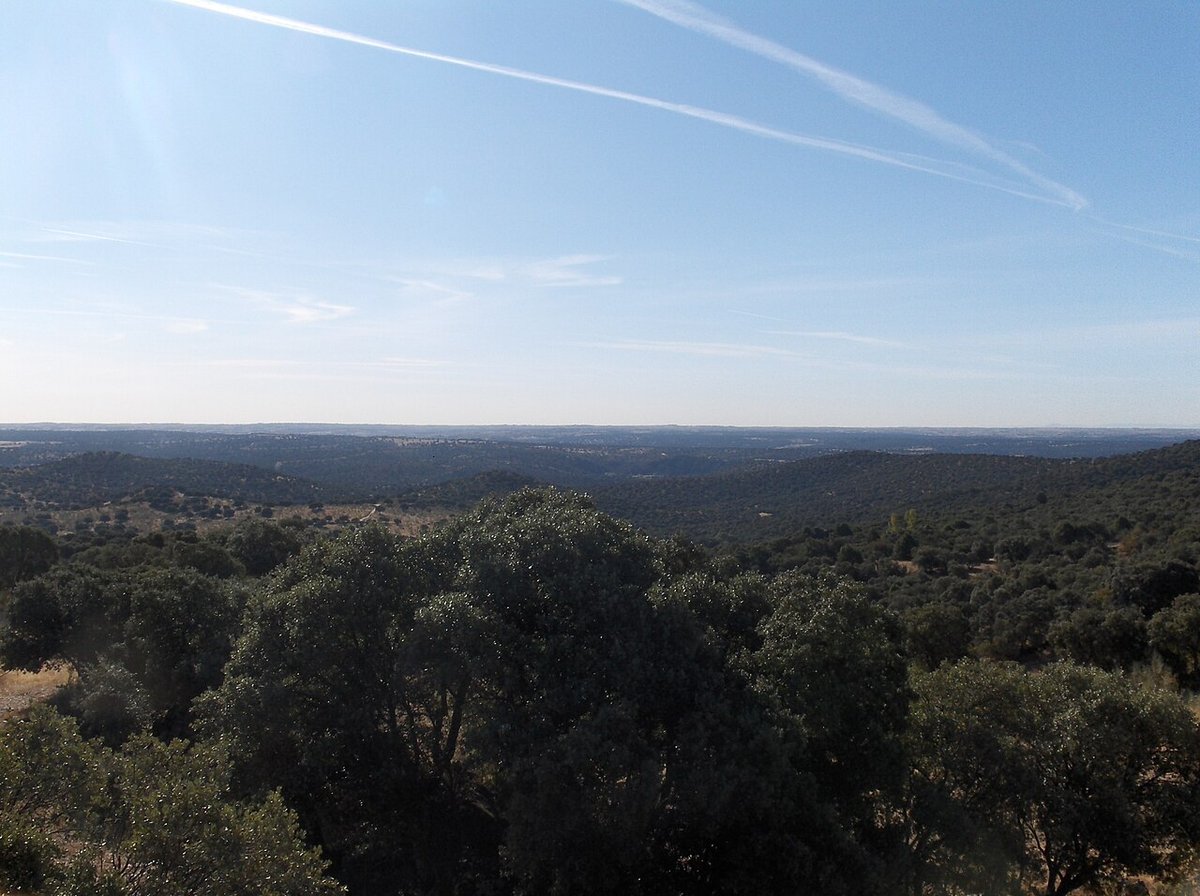
Another option from the village is a track towards Robledo de Chavela that crosses the dehesa, a traditional area of pasture dotted with holm oaks. It is a longer, uncomplicated walk among trees and grazing livestock, suitable for stretching your legs without tackling anything demanding.
Local Flavours and Village Life
In the main square there are a couple of long-established bars. At weekends they tend to serve traditional dishes, including hearty stews and grilled meat. The atmosphere is local rather than geared towards large numbers of visitors.
The area is known for growing garbanzo of the escabechero variety, a type of chickpea that has a solid reputation in the comarca, or local district. It appears in regional cooking and is part of the agricultural identity of the area.
Sierra honey is also easy to find, sold in village shops or at local stalls. It reflects the surrounding landscape of hills and woodland, where beekeeping has a place alongside farming.
Festive Dates on the Calendar
At the beginning of May, Fresnedillas celebrates the Fiesta de la Vaquilla. It has been declared of regional tourist interest, and that weekend the village fills up more than usual. Activities take place in the streets and the mood is lively.
In August come the fiestas patronales of San Bartolomé, the village’s patron saint. These days include a procession, music and open-air evening celebrations known as verbenas. The feel is that of a small community event rather than a large-scale festival.
On 15 May there is usually a romería, a traditional pilgrimage, towards the dehesa. It is another date when the village sees more movement than on a normal weekend.
Getting There and When to Go
From Madrid, the drive takes a little over an hour. The route follows the A-6 and then roads through the Sierra Oeste, with the M-521 covering the final stretch to the village. In some sections this road is narrow, and after rainfall potholes and puddles can appear.
On Sunday afternoons traffic tends to build on the return towards Madrid.
Fresnedillas de la Oliva works best as a short stop. The Museo Lunar, a walk through the centre and, if the weather suits, the Civil War fortines in the pine forest are enough to fill a morning. It pairs easily with Robledo de Chavela or other villages in the Sierra Oeste.
The visit is brief, but the story it carries is unusual. For a period in the 1960s, from this hillside in the Sierra Oeste, people were speaking to the Moon. That detail alone gives this small village a place on the map beyond its size.