Full Article
about Villamantilla
Quiet little town surrounded by countryside; perfect for easy hiking.
Hide article Read full article
A Village That Wakes Gently
At the hour when the sun begins to brush the façades, Calle Mayor in Villamantilla is still half empty. A shutter rattles upwards somewhere. A broom scrapes lightly across the ground. The light comes in low and almost horizontal, sliding over pale walls and stone skirting. Tourism in Villamantilla has little to do with tight schedules or long itineraries. Things move slowly here, and mostly in plain sight.
The village lies in the Sierra Oeste of Madrid, at just over 500 metres above sea level. It is small, with barely more than 1,500 inhabitants, and its layout has shifted little over the years. Short streets, houses pressed close together, interior courtyards hidden from view. By mid-morning there is usually a little more movement in the main square, where neighbours sit and talk while the church bells mark the hour.
Villamantilla is not a place of grand gestures. It is understood through small details: the texture of a wall, the weight of a wooden door, the rhythm of daily life that repeats without fuss.
San Juan Bautista and the Heart of the Village
Near the centre stands the parish church of San Juan Bautista. It is not a building that dominates the skyline, yet as you approach, its details come into focus: stone darkened slightly by time, a heavy entrance door, an interior that remains cool even in summer.
The church has ancient origins and has undergone several renovations over the centuries. This is visible in the mixture of elements and in certain pieces of the altarpiece, where styles and periods overlap. Nothing feels staged. Instead, the building reflects the gradual changes of a community that has adapted its church as needed.
Inside, there is usually silence. Footsteps echo softly, and sometimes the door can be heard closing behind a visitor. On a hot day in the Sierra Oeste, the drop in temperature offers a brief pause from the glare outside.
From the church, it takes only a few minutes to reach the square again. The distances are short, and there is no fixed route to follow. The village invites wandering rather than ticking off sights.
Short Streets and Patches of Shade
The historic centre can be covered quickly, though it is worth taking time. Some façades still show layers of limewash and adobe. Others reveal irregular stonework beneath. Wrought-iron balconies appear unexpectedly along narrow streets where the sun reaches the ground for only a few hours each day.
Every so often, the streets open out into small squares with trees. Elms or plane trees provide shade in summer and change the feel of the space entirely. In the early afternoon, when the heat presses down in the Sierra Oeste, these corners often fall almost silent.
There is no dramatic shift between one street and the next. Instead, there is a steady continuity: similar heights, similar materials, a sense that the village has grown without breaking its own scale. Even the newer elements seem to follow the same rhythm.
By midday, Villamantilla tends to retreat indoors. Doors close, blinds lower, and the most consistent sound is that of a latch clicking shut. The streets empty out, and the light becomes harsher, flattening colour and shadow alike.
Paths Through Holm Oaks
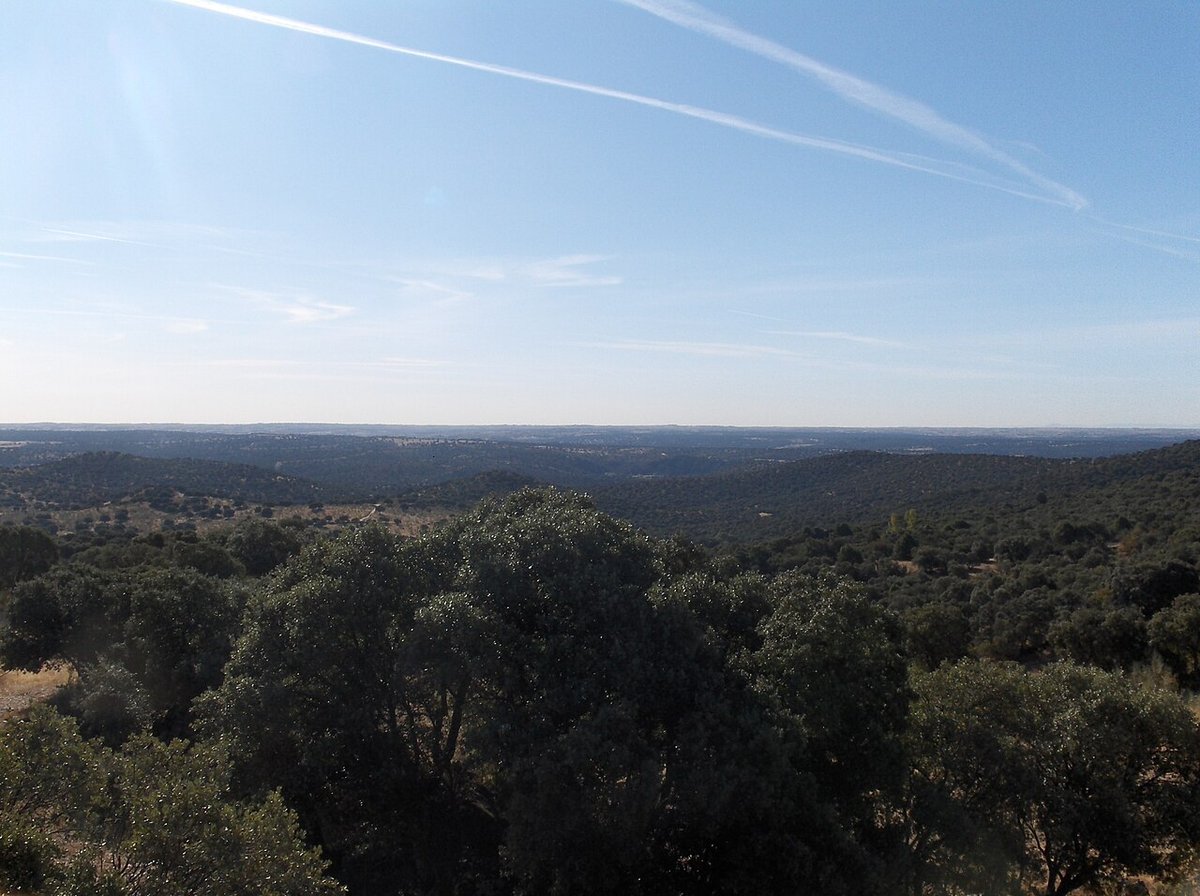
Just a few minutes on foot from the edge of the village, dirt tracks begin. They lead out towards open countryside dotted with encinas, holm oaks spaced across pastureland known as dehesa. In summer the ground is pale and dry. In winter, some stretches can turn muddy.
Signposting is limited. Even so, the routes are easy enough to follow as long as the village remains in sight on the return. In one or two hours it is possible to walk across gentle hills and fields that shift with the seasons: green cereal crops in spring, yellow tones as early summer approaches.
The landscape is open and largely unshaded beyond the built-up area. It is wise to avoid the central hours of the day when temperatures rise, as there is little protection from the sun. The sense of space is broad rather than dramatic, with long views over undulating ground and the outline of holm oaks marking the horizon.
These paths do not promise landmarks or viewpoints with names. Their appeal lies in the gradual change of colour and light, and in the steady crunch of dry earth underfoot.
Home Cooking and Long Conversations
Food in Villamantilla remains straightforward and rooted in habit. When the cold sets in, spoon dishes appear, warming stews and broths that suit winter days. At family gatherings there are roasted meats. During the appropriate season, products from the pig take centre stage, following traditions that have long shaped rural cooking in this part of Spain.
These are recipes passed from one household to another more by repetition than by any deliberate effort to preserve them. They belong to the everyday rather than to a display of regional identity.
On many tables, the classic tarta de galleta makes an appearance. This biscuit cake is built from soft layers of biscuits, sweet cream and a topping of chocolate. It tends to arrive at the end of the meal, when conversation has already slowed and nobody seems in a hurry to stand up. The meal stretches into a sobremesa, the Spanish custom of lingering at the table to talk after eating, as much a social ritual as the food itself.
Dates Marked in the Calendar
The main celebrations revolve around San Juan Bautista, towards the end of June. During those days there are processions and events organised by the neighbours themselves. The scale reflects the size of the village, with participation coming from within rather than from outside.
In August, the summer festivities bring more movement to the streets. Activities vary from year to year, but the atmosphere changes noticeably, with greater activity in public spaces.
By November, in some households, the tradition of the matanza continues. This is the slaughter of the pig, a practice that historically provided meat and cured products for the months ahead. It is not a public event. Instead, it remains a family custom, repeated when the cold arrives.
These moments punctuate the year without altering the underlying pace. Once the celebrations pass, the village settles back into its familiar rhythm.
A Brief Walk Through Villamantilla
Villamantilla reveals itself quickly. From the square, it is easy to walk along Calle Mayor, step into the church of San Juan Bautista and turn down a side street before heading out towards the country paths. In a couple of hours there is enough time to see it calmly.
Around midday the village draws inwards. The streets are almost empty, and the most regular sound is a door closing somewhere out of sight. Towards sunset, people reappear in the square. The light softens, and the encinas around the village begin to darken the horizon.
It is probably the quietest moment to walk here, when the day cools and the outlines of houses and trees lose their sharp edges. Villamantilla does not demand much time. It simply asks for a slower pace, and rewards it with a clear view of how the day unfolds in a small corner of the Sierra Oeste of Madrid.