Full Article
about Villanueva de Perales
A simple, welcoming village that keeps its rural traditions and natural setting.
Hide article Read full article
The Road That Changes Pace
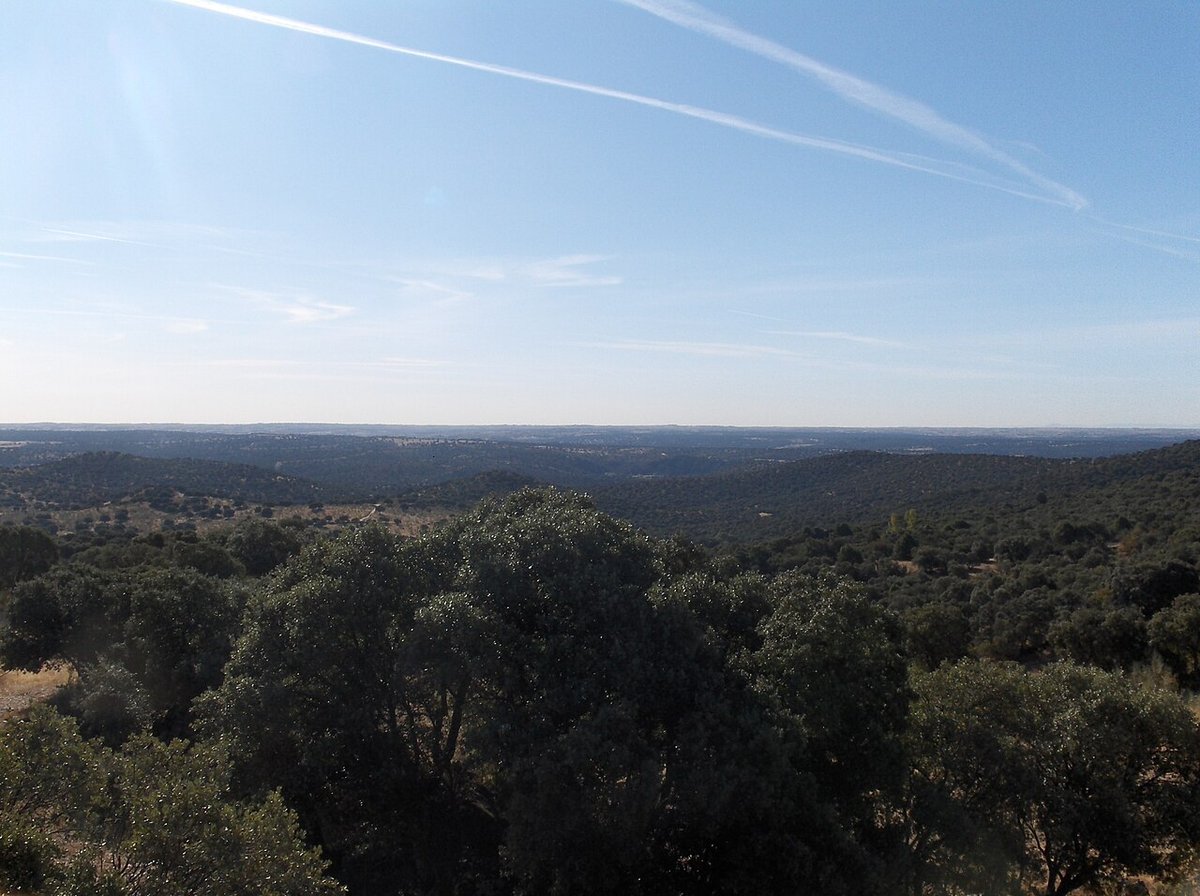
There is a point where the M-501 stops feeling like an urban dual carriageway with a hard shoulder and starts behaving like what it really is: a road cutting through open countryside, with scrubland and holm oaks on either side. Traffic thins out, the tarmac narrows, and suddenly a sign appears: “Villanueva de Perales, 8 km”. Just after that, a petrol station that looks closed but rarely is.
That is where visiting Villanueva de Perales begins to make sense. It is not somewhere you stumble upon by pure chance, yet it is also not the sort of place that appears on every travel list.
A Village That Broke Away
The story of Villanueva de Perales has something of a family disagreement about it, the kind that ends with someone moving next door. For a long time it depended on Perales de Milla, a settlement that no longer exists as a municipality. At some point in the 19th century, the residents decided to organise themselves independently and build their own centre, complete with church and administration.
It remains a small village, with just over 1,700 inhabitants. The urban area can be crossed quickly, ten minutes at an easy pace. Streets slope noticeably, granite walls line the way, and there is a clear sense that the village sits where the terrain allowed rather than where it would have been most convenient.
One building stands out for different reasons. The town hall, designed by Miguel Fisac in the late 20th century, contrasts with its surroundings. Its modern style can feel unexpected at first glance. It does not clash exactly, but it has the effect of spotting a very modern object in a traditional setting. It makes you look twice.
Along the Historic Drovers’ Routes
The most interesting parts of Villanueva de Perales are often found beyond the village itself. Two major cañadas reales pass through the area: the Segoviana and the Leonesa. These were historic routes used for transhumance, the seasonal movement of livestock across Spain. Even now, their presence is easy to recognise in the landscape, wide tracks edged by holm oaks and fences.
Today, these routes serve several purposes. Occasionally, flocks still pass through, but it is more common to encounter walkers, weekend cyclists or locals out for a long stroll with the dog.
Looking more closely, traces of more recent history also appear. Along the Cañada Real Segoviana, several machine-gun nests from the Spanish Civil War remain, partly hidden by vegetation. They are not specially signposted and tend to appear unexpectedly, as if left behind and largely ignored ever since.
The countryside also holds references to an older past. The former settlement of Valdetablas is often mentioned in the area. Very little can be seen today, perhaps a low wall or scattered stones, and there is still some debate about exactly when it was abandoned.
When the Village Fills Up
In early May, the festival of the Cristo de la Campana takes place, and the rhythm of the village changes completely. Residents from nearby towns arrive, along with relatives who live in Madrid and many who return just for that weekend.
One of the central events is the encierro with young bulls, held along one of the steepest streets in the village. It does not last long, but while it is happening the atmosphere is intense. Afterwards come the procession, gatherings in the square and simple communal meals. Dishes such as eggs with chorizo are shared, treated here as part of a long-standing tradition.
Locals joke that people come “even from Madrid”, as if it were a distant journey, when in reality the capital lies just over forty kilometres away.
The Church at the Centre
The Church of San Sebastián anchors the centre of Villanueva de Perales. It is neither large nor particularly ornate, yet it has stood for centuries and continues to serve its role. Its bells, said to be old, still mark the passing hours.
The square around it carries the quiet feel typical of small villages. Granite houses line the edges, a bench or two is usually occupied, and in winter there is often the smell of firewood drifting from nearby chimneys.
Inside, everything is restrained. Wax, dark wood and a kind of silence that comes from spaces where only a few people gather at a time.
A Stop That Depends on Expectation
Whether Villanueva de Perales is worth a stop depends largely on what you are looking for. Anyone expecting a place full of visitor-oriented shops or terraces designed for long afternoons will not find that here. The pace is different.
On the other hand, it suits those who enjoy setting out without a fixed plan, walking until a track leads off between holm oaks for kilometres, and crossing paths with only a handful of people along the way.
A simple approach works best. Arrive on a quiet morning, spend some time around the square, and head up to the pine grove on the outskirts. It only takes a few minutes, though the incline is noticeable. From there, continue through the Sierra Oeste. Villanueva de Perales works well as a short stop: enough time to understand the place, then carry on the journey.