Full Article
about Caravaca de la Cruz
Hide article Read full article
A race against the slope
On the second of May, before the sun clears the castle walls, people in Caravaca drape their horses in cloaks stitched with silk and gold thread. This isn't mere decoration. It's the prelude to a sprint up a steep, cobbled street where the rider struggles to stay mounted. The crowd's roar and the animal's exertion set the tone for a day built on risk. The event is Los Caballos del Vino, and it frames how the town understands itself—a persistent negotiation between devotion and danger.
The run is brief, maybe two hundred metres, but the gradient forces horse and handler into a frantic, all-or-nothing effort. Spectators press in, turning the narrow lane into a tunnel of noise. Every attempt could end in a fall, and that possibility is central to its meaning. The festival doesn't eliminate uncertainty; it stages it. For Caravaca, that balance between faith and chance sits at its core.
The relic and the rise of a sanctuary
Caravaca’s significance stems from the Vera Cruz, a sliver of wood held to be from the True Cross. Its authentication by the Vatican in the late 20th century confirmed what local tradition had long claimed. This relic transformed a former Templar castle into one of only five holy sites in the world granted a perpetual Jubilee Year, placing this town of some 26,000 people in a rare category alongside Rome and Jerusalem.
The fortress guarding the cross began as an Islamic hisn in the 12th century, positioned to control routes between the coast and the interior. Inside the walls, the Torre Chacona holds a private bath, an uncommon luxury in Iberian Moorish fortifications. After the Christian conquest in 1243, the Order of Santiago took over from the Templars and eventually built the basilica that now crowns the hill. A military stronghold gradually became a pilgrimage destination.
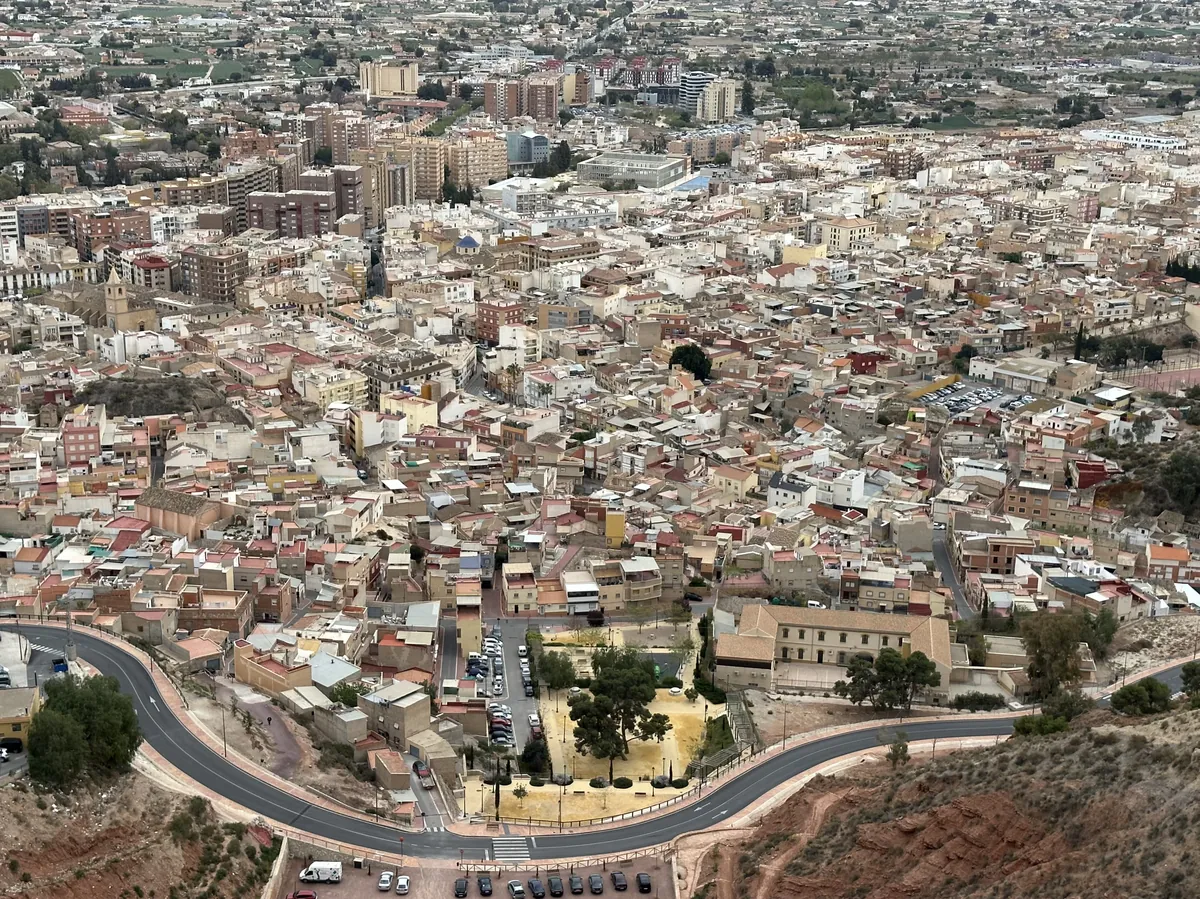
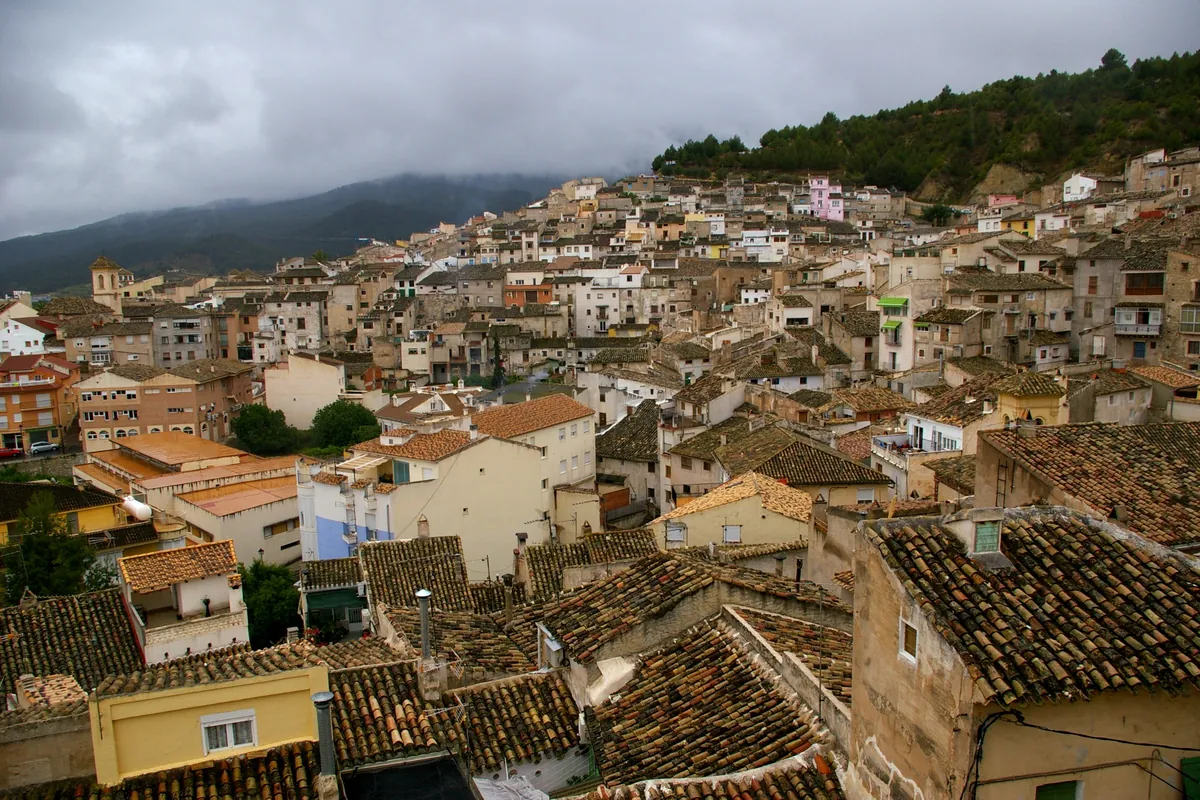
That shift still dictates the town's layout. The hilltop complex dominates every view, and the streets below coil upward toward it. The hierarchy is physical and intentional, with the sanctuary as the fixed point for both liturgy and daily life.
Baroque architecture on a steep hillside
The Basílica del Santuario is a structural answer to a problematic site. Constructed on a sharp drop, it operates on two levels. Its main façade doesn't face a plaza; it confronts the void, addressing the sheer fall of the land. This gives the building its particular stance, as if it grew from the rock rather than being placed upon it.
Inside, the polychrome marble high altar pulls focus. Above it, a dome channels light down toward the relic's chamber. The effect is deliberate, concentrating attention on the Vera Cruz without spectacle. The upper church handles ceremony, while the lower level connects directly to the street grid.
The ground floor, once a stable yard for festival horses, now houses the camarín of the Virgen de la Esperanza. Each eighth of September, her image is carried from its hermitage to the basilica in a three-hour procession. The town reorganises itself for this movement; normal circulation pauses as the route becomes the only relevant path. It's a familiar journey that temporarily rewrites how urban space is used.
Food shaped by dry land
The cooking here mirrors the constraints of inland Murcia. Dishes are built for sustenance, not complexity. Michirones, a broad bean stew with panceta and chorizo, was field hands' staple food. Olla de trigo, a thick porridge of wheat and meat, served against winter cold.
Goat's cheese from the Montes de Caravaca is cured in stone and carries notes of thyme from the hills where the animals forage. The flavours are straightforward, tied to place more than technique. Wine follows a similar logic. The nearby D.O. Bullas grows garnacha tinta on slate terraces; its reds and claretes are typically served without ceremony, often as the only wine on the table.
Meals speak of continuity over variety. Recipes haven't strayed far from their origins, shaped by what the dry terrain yields and the need to make it last.
Moving through Caravaca
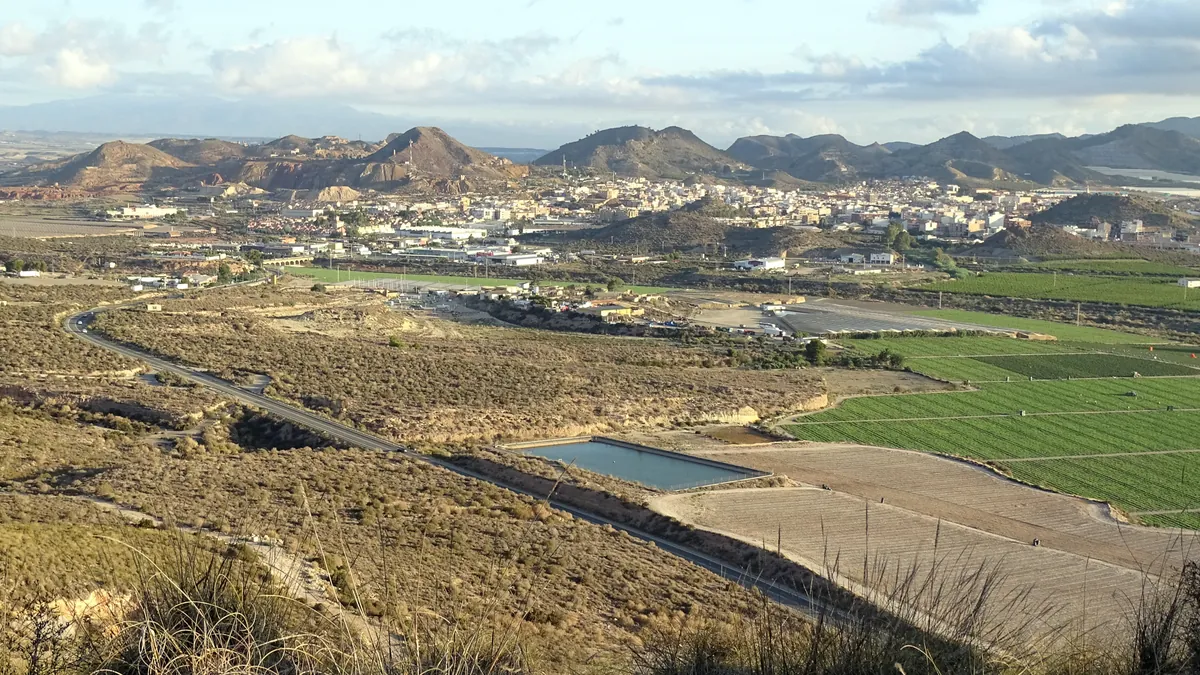
From Murcia city, it's about 80 kilometres northwest via the A-30. The final approach climbs roughly 400 metres into the sierra. You'll see the basilica among pine trees long before you arrive.
Park at the castle car park; the historic centre is largely pedestrian. From there, explore on foot. Calle Mayor lines up 16th-century manor houses, their façades still bearing coats of arms and period wrought-iron grilles. The street feels lived-in, not preserved.
For a walk outside the core, the path to the Fuentes del Marqués starts in town and leads to a spring under old olive trees. It traces an old Roman road, linking your steps to much older journeys. The sound here is running water, not traffic.
If your visit coincides with the May fiestas, Caravaca's rhythm changes entirely. Time is marked by rocket bursts, and access to main streets becomes difficult. The town transforms from a place you visit into a stage where tradition is enacted. The celebrations don't just happen here; they dictate how the town moves, sounds, and functions for those inside it.