Full Article
about Araitz
Valley dominated by the towering Malloas de Aralar; deep-green landscape dotted with scattered farmhouses and wild nature.
Ocultar artículo Leer artículo completo
At 550 metres above sea level, Araitz sits low enough for holm oaks and walnut trees, yet the village green still tilts sharply enough to send runaway footballs into the drainage ditch. Look east and the ground rises almost immediately to 1,400 m of karstic grey: the Sierra de Aralar, a solid wall that traps Atlantic weather and fires it back as sudden valley mist. The temperature can drop eight degrees between morning coffee on the church steps and the first bend of the walking track. Pack a fleece even in July.
The Village that Forgot to Shout About Itself
Five hundred people live here, scattered across stone houses that hide behind stone walls. Generations ago someone carved 1673 above a doorway; the iron balcony above it is newer, 1890s perhaps, already rusting again after last year’s repaint. You will not find souvenir shops. The only public noticeboard lists the price of second-hand tractors and the date of the next blood-donation drive. British number plates are so rare that locals assume you are lost and will direct you, kindly, back to the main road.
That road is the NA-2400, a single carriagement that ribbons uphill from Etxarri-Aranatz. Sat-navs mis-pronounce every Basque junction; better to follow the yellow “Araitz” arrow painted on a breeze-block wall beside a cider barn. After that the asphalt narrows, hedgerows disappear, and you enter a legal livestock zone where sheep have absolute right of way. Allow twenty minutes for the final eight kilometres; refuse collectors cannot pass a wandering ewe any more than you can.
What You Actually See When You Walk Around
Start at the church of San Martín de Tours. The door is usually open; if not, the key hangs on a nail inside the bar opposite. The nave is dim, the floor uneven; Romanesque ribs survive only in the exterior apse, like an older skeleton wearing a later skin. Walk the perimeter and you will spot masons’ marks, a blocked leper window, and a stone trough the parish now fills with holy water only when the bishop visits.
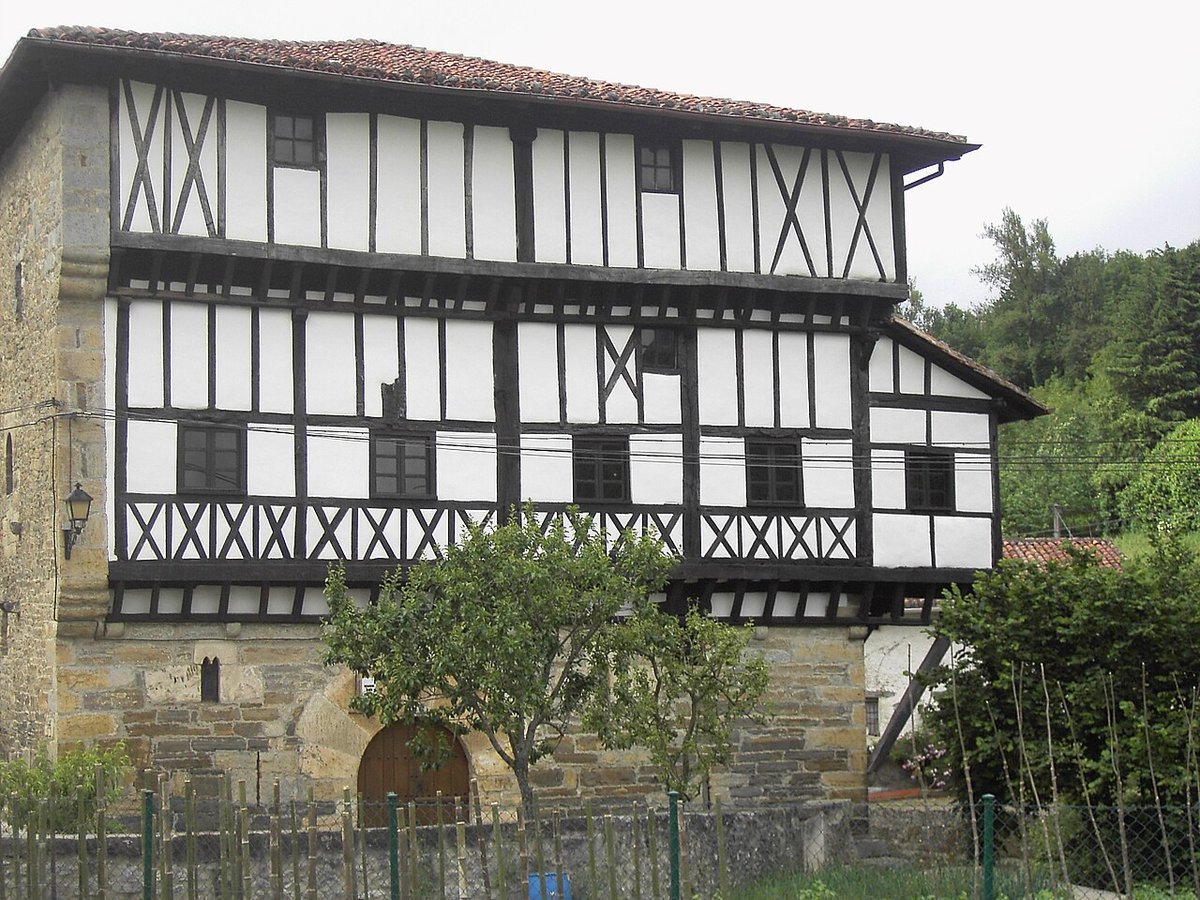
From the church door, three lanes fan out. Calle Mayor keeps the best seventeenth-century houses: chunky ashlar, coats of arms worn smooth, wooden gutters fat as railway sleepers. Many roofs still grow the traditional sparse grass; in June the village council hoists a man onto each gable to scythe it, exactly as they did three centuries ago. The lane ends at a drinking trough where two stone mills slump beside the river. You cannot enter—the beams collapsed in 2014—but peep through the door and you can still read “1842” chalked on a grain hopper.
Cross the plank bridge and you are suddenly in hay meadow country. The path is a green corridor between waist-high grass and shoulder-high walls. Every fifty metres a wooden gate bars the way; learn the local etiquette: lift the latch, close behind you, greet any cow that lifts its head. After fifteen minutes the valley opens and the limestone wall fills the horizon. Stop here; mobile signal dies within two hundred metres. This is your cue either to turn back or commit to a proper mountain day.
Choosing Your Altitude
Short on time? Follow the yellow-arrow PR-AI02 that loops through the hamlets of Iriartea and Araitz-Beherea. The circuit is 4 km, almost level, and passes two stone crosses and a spring whose water locals swear cures hangovers. Allow ninety minutes including photo stops and gate negotiations.
Feeling energetic? Keep climbing on the same track and you will meet the GR-20, the long-distance backbone that crosses Aralar from Zestoa to the Ultzama pass. Turn left (north-east) and three hours of steady ascent bring you to the col of Txurtxur, 1,160 m, where the views jump across to the Pyrenean ridge and the Atlantic clouds roll in like a slow-motion wave. The path is obvious but carries no handrails, no snack kiosk, no rescue phone. Cloud can descend in minutes; if visibility drops, retrace your steps—Aralar eats compasses for breakfast.
Winter alters the deal. Snow usually arrives by mid-December and lingers on north-facing slopes until March. The NA-2400 is cleared only as far as the last farm; beyond that, walkers need crampons and the council’s permission to open the barrier. On bright days the plateau becomes a white silence broken only by woodpeckers and the occasional grazing pony. On grey days the valley feels submarine: damp, colourless, closed. Bring boots you do not mind ruining with red mud.
Eating (and Not Eating) in Araitz
There is one bar, Karmen, beside the church. Opening hours are 08:00–14:00 and 17:00–21:00, but if no one is drinking she locks at 13:30. A coffee costs €1.30, a caña €2.00, and the tapas are whatever Joxe’s mother has cooked that morning—perhaps chorizo stew, perhaps fried trout. The menu is written on a blackboard in Spanish; no English is spoken, yet pointing works. Cards are accepted only above €10; otherwise keep euro coins.
A full meal means booking ahead. Casa Rural Araitz will cook for guests if requested 24 hours earlier: expect chuletón to share (€28 per person including wine) followed by cuajada, the local set yoghurt drizzled with honey. Vegetarians get tortilla, salad and repeated assurances that the cheese “is definitely sheep, not cow”. The nearest alternative restaurant is in Etxarri-Aranatz, an eight-kilometre drive on a road with no street lights and frequent suicidal wild boar.
When to Come, When to Stay Away
May and June dress the valley in an almost hurtful green; orchids appear in the meadows, nights stay above 10 °C, and swallows return to rebuild mud nests under the church eaves. September adds gold to the beech woods and brings mushroom hunters in discreetly marked cars; they park thoughtfully, speak in whispers and guard the locations of their boletus patches like state secrets.
August is fiesta month: San Bartolomé, three days of Basque pelota tournaments, outdoor dancing and a paella the size of a tractor tyre. The village population quadruples, accommodation within fifteen kilometres sells out, and Saturday-night revellers keep the plaza awake until 05:00. If you want silence, arrive mid-week and camp elsewhere.
November to March is the empty quarter. Days finish at 17:30, fireplaces smoke all afternoon, and the bar may close early if the regulars are watching Osasuna on television. Yet the emptiness is also the point: you can walk the GR-20 for two hours and meet no one, hear nothing but your own breathing and the clack of walnut branches overhead.
Leaving (and Perhaps Returning)
Araitz offers no postcard moment, no single Instagram frame that will make London friends jealous. Instead it gives small, specific memories: the smell of fresh-cut hay that drifts through the car window; the sound of a gate latch dropping into its stone slot; the sudden warmth of Joxe’s bar when you step in from horizontal rain. You will probably leave after one night, satisfied that you have “done” the valley. Weeks later, stuck on the M25, you may find yourself wondering who scythed the grass roofs this year—and whether the spring water really does cure hangovers.