Full Article
about Monreal
Landmark on the Camino de Santiago at the foot of La Higa; medieval town with stone bridge and castle ruins
Hide article Read full article
A slow walk through stone and silence
By mid-morning, before the sun fully warms the air, the walls of Monreal still hold a damp grey tone. The streets remain quiet, with footsteps on cobbles more noticeable than passing cars. A walk through the old quarter reveals worn coats of arms on façades, stone arches darkened by time, and doorways that hint at inner courtyards. The place unfolds at an unhurried pace, almost without noticing.
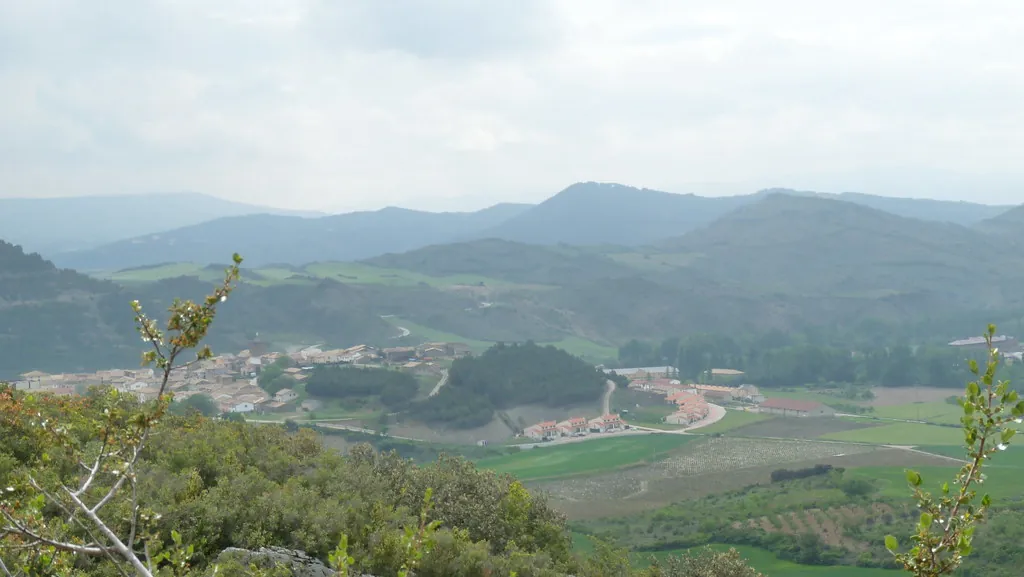
Monreal is a small town in Navarra with around 490 inhabitants, set at about 555 metres above sea level. It opens onto a valley of soft hills. A short climb along the streets facing north changes the horizon, with the first outlines of the Pyrenees beginning to appear beyond the ridges. To the south, the land flattens into farmland that shifts in colour with the seasons. This in-between position helps explain why the town once relied on walls and watchfulness for centuries.
Inside the walled enclosure
The walls of Monreal, built between the 13th and 14th centuries, still define the heart of the town. Circular towers frame the entrance and stand out from a distance. Crossing through them is worth the effort, as the interior reveals a different rhythm. Streets are narrow and somewhat irregular, typical of medieval settlements that grew without strict planning.
As you move through the lanes, houses display carved coats of arms set into stone. Old iron grilles cover windows, and walls show a mix of masonry and plaster in varying tones. The overall look is not uniform. Some façades have been carefully restored, while others show fine cracks or shifts in materials that point to changes over time.
The church of San Martín, built between the late 15th and early 16th centuries, rises above the surrounding roofs with its tower. From the steps and nearby spots, the view opens onto the valley of the river Elorz. Meadows, cultivated plots and paths stretch out between low hills. Within the same compact centre stands the palace of the Rada family, a Renaissance building with more restrained lines than the neighbouring houses.
A morning route through Monreal
Monreal is small enough to explore comfortably in a couple of hours. A natural place to begin is the entrance to the walled enclosure. From there, following the line of the walls helps make sense of how the town’s defences once worked.
After that, the best approach is to wander through the interior streets without a strict plan. This leads naturally towards the area around the Casa Consistorial, the town hall, and then up towards higher points near the walls. From these elevated spots, the valley opens wide. Roads curve through the landscape, tracing gentle lines across the terrain. On clear days, the light later in the day casts long shadows across the fields.
What visitors often overlook
Some visitors stop at the entrance, take a few photos of the towers and move on. That approach misses much of what gives Monreal its character. The interior holds more interest than it first suggests, especially in the details of the houses and the views from the upper areas.
There are also a few practical points to keep in mind. The ground can be uneven in several sections. Cobbled streets and slight slopes may become slippery after rain, which is relatively common at certain times of year. Comfortable footwear makes a difference.
Expectations matter here as well. Monreal can be explored quickly. It works best as a calm stop within a wider route through the Sangüesa area rather than as a place to fill an entire day.
A place that reveals itself quickly
From outside, the walls can give the impression of a large or monumental town. Once inside, the scale becomes clear almost immediately. The main elements appear within minutes: the towers, the church, the houses marked with coats of arms.
This compact size has its own appeal. It allows attention to settle on small details. A very old wooden door, the sound of wind moving through narrow streets, the contrast between pale stone on one façade and darker tones on another. It does not take long to form a clear sense of the place.
Getting there and planning your visit
Monreal is easily reached by car from Pamplona via the A‑21 towards Jaca, followed by a turn onto a local road leading into the town. Access is straightforward, and it is usually possible to park near the historic centre.
Conditions can vary with the weather. In winter or on windy days, the upper areas near the walls tend to feel colder. Early morning is often the quietest time to walk through the streets if you prefer a near-silent atmosphere. Allow between one and two hours to explore at a relaxed pace.