Full Article
about Eulate
Améscoas village with a historic palace; close to the Urbasa range.
Hide article Read full article
A wooden door opens and closes somewhere along Calle Mayor. The sound hits the stone walls and comes back as a short echo. At that hour of the morning, Eulate is just a village: a neighbour crossing the square, smoke drifting from a chimney, dry leaves scraping along the ground.
It sits in Tierra Estella, in Navarra, with fewer than three hundred inhabitants. The streets are lined with grey stone walls and wide entrances once designed for carts and animals. At its centre stands the church of San Martín. Its origins are usually placed in the medieval period, though it has been altered over time. Inside, there is dark wood, worn benches and the dense quiet typical of small rural churches when they are empty.
Traces of work in the stone
Walking through Eulate reveals farming life on almost every façade. Low doorways, thick lintels and small openings that once ventilated stables still mark the buildings. Some wooden doors have taken on a silvery tone after years of exposure to rain and sun.
Several houses display carved stone coats of arms. They are not especially large or decorative, yet they point to long-standing family homes in the valley. Close to the oldest part of the village, small kitchen gardens sit right up against the houses. On damp days, the smell of turned earth reaches out into the street.
The layout and materials are practical rather than decorative. Everything suggests a place shaped by work and routine. Even small details, such as tool marks in the stone around a doorway, remain visible if you look closely.
Where the streets end
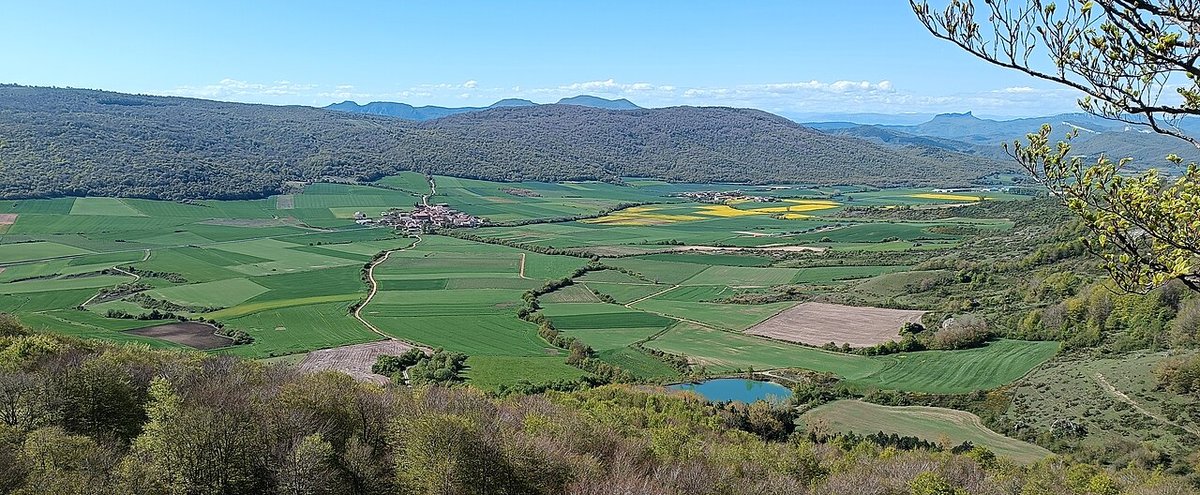
To the north, the village opens out into fields and stretches of oak and beech woodland. The terrain is gently uneven, so the horizon appears in bands of green and darker tones rather than long, uninterrupted views. Autumn brings a thick layer of leaves that softens the ground and quietens footsteps. Spring introduces a brighter, more intense green across the slopes.
Within the village itself there are several fountains. One of them, with three stone spouts, often serves as a passing point for people heading out towards the paths that lead into the valley. These small features are part of everyday life rather than landmarks.
The transition from built space to open land happens quickly. A short walk is enough to move from enclosed streets into woodland edges, where the light begins to change.
Walking out towards the Ega
The paths that leave Eulate follow older routes linking nearby villages. Some climb towards higher ground in the surrounding hills. The ascent is steady, and in certain stretches there is loose stone underfoot, so sturdy footwear is advisable.
Early in the morning, the woodland is active. Blackbirds can be heard, along with the tapping of a woodpecker. With a bit of quiet and patience, birds of prey may be seen gliding above the clearings.
Seasonal changes affect how these paths feel. Summer heat is noticeable on exposed sections, which makes earlier starts more comfortable. Autumn brings damp conditions, and the ground can be more slippery than it first appears.
The routes are not presented as formal hiking experiences with marked stages. They are working paths that have been used over time.
A practical rhythm
A few hours are enough to explore the centre of Eulate without rushing. The church, the nearby streets and the fountains can all be seen at a slow pace. After that, it is worth heading a short distance along one of the paths towards the hills. There is no need to go far to notice the shift from village to woodland.
Bring water and something to eat; services in Eulate are limited and shops are not plentiful. A light extra layer is also useful, even on clear days, since the weather in this part of Navarra can change quickly.
The village does not lend itself to hurried visits. Its character becomes clearer when time is allowed to pass more slowly: the sound of gravel underfoot in an empty street, or a pause beside the gardens while wind moves through nearby oak trees.
Getting there and when to go
From Pamplona, follow the A-12 towards Estella-Lizarra, then continue along smaller regional roads into the valley. The journey is around fifty kilometres. In winter, check the weather before setting out; roads in the area can be affected by snow or ice.
Rain changes everything underfoot around Eulate. Paths turn muddy, and stones hide beneath shallow puddles.
Come on a weekday if you can manage it. The pace here is slow by nature; weekends can feel different when more cars arrive from nearby towns. Most things here unfold gradually—the light moving across a stone wall, a door closing somewhere up the street—and that pace is part of what defines it.