Full Article
about Genevilla
A remote village on the border with Álava, noted for its church altarpiece and the Sierra de Codés setting.
Hide article Read full article
A Quiet Start in a Small Place
The first light of the day reaches Genevilla from the side of the church and settles on the grey stone of its houses. At that hour there is barely any movement. A window opens here, a wooden door sounds there, and little else breaks the stillness. Visiting Genevilla begins in that subdued way, with the village half asleep and footsteps echoing along its narrow streets.
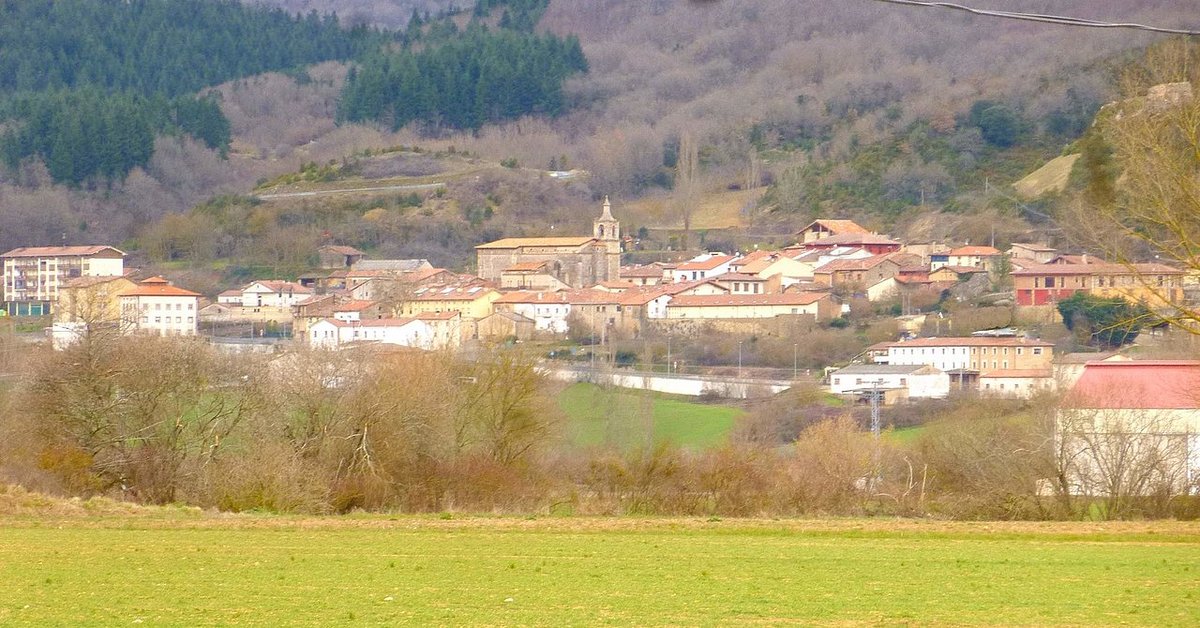
This is a very small settlement in Tierra Estella, close to the boundary with Álava in northern Spain. Fewer than a hundred people live here, and that scale shapes everything. The pace is slow, and the layout is compact. The village gathers around the church of San Miguel Arcángel, which anchors the centre both visually and socially.
Stone, Shields and Short Distances
Genevilla is not large, and that becomes clear almost immediately. You can cross it from one end to the other in just a few minutes. Still, it rewards a slower look. The walls of the houses are built in worn stone, their surfaces marked by time. Several doorways display old coats of arms, darkened over the years but still visible if you pay attention.
The details stand out: wooden eaves that have deepened in colour, wide gateways that once opened into farmyards, and façades that show how the village has adapted without losing its original form. Everything feels close together, gathered around the church and the small network of streets that rise and dip gently.
Those streets do not follow a strict pattern. Some slope upwards, others down, and a few end in small open spaces or lead straight out towards the countryside. The transitions are quick. One moment you are between stone houses, the next you are looking out over fields.
Where the Village Meets the Fields
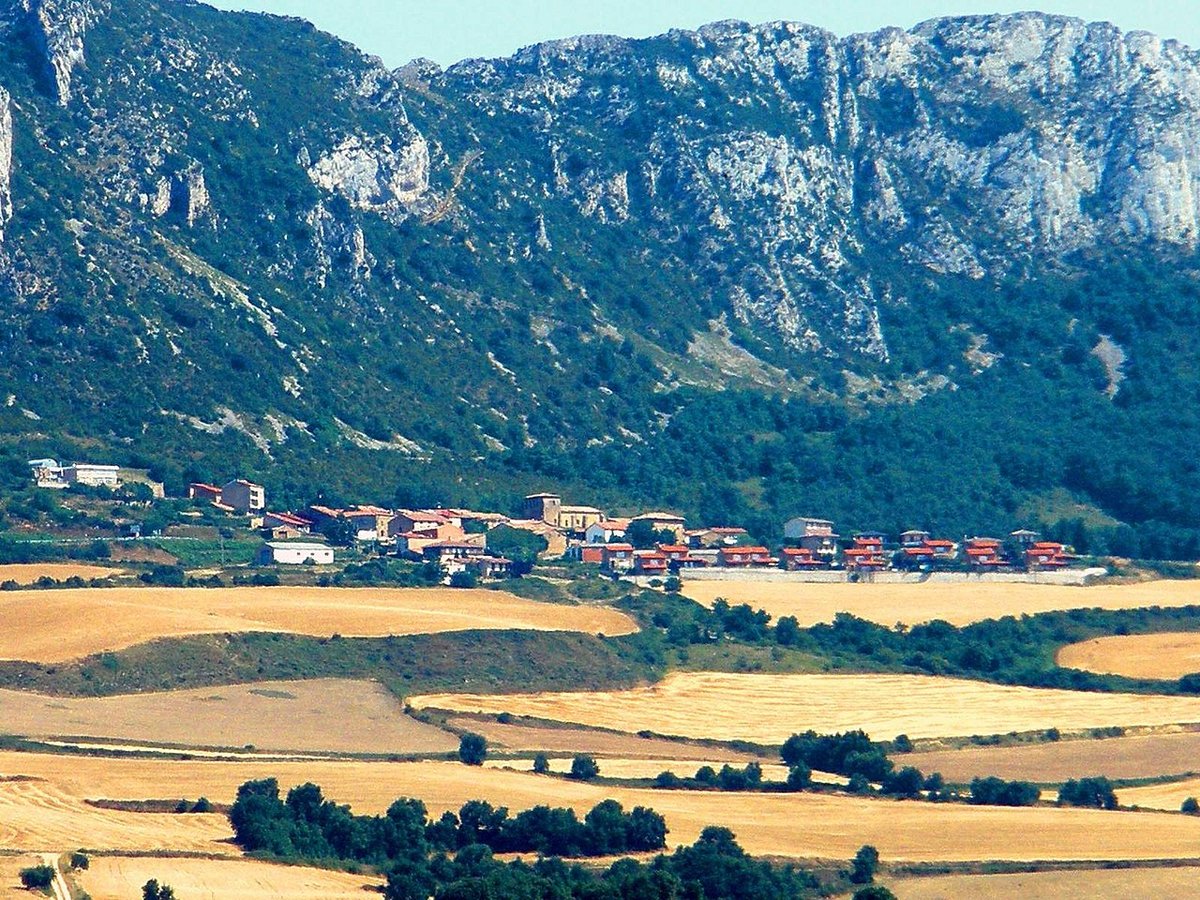
The edge of Genevilla is abrupt. Once you leave the last cluster of houses, the landscape shifts immediately into open agricultural land. There are plots of cereal crops, tracks used by farm vehicles, and scattered patches of holm oak and low oak trees. On clear days, the view stretches out to the south, where the farmland extends with very few obstacles.
The surroundings are easy to explore on foot. There are many dirt tracks created for agricultural use. They are not usually signposted as walking routes, but they are simple to follow and connect naturally with one another. Walking here does not require a plan so much as a willingness to wander.
The character of the landscape changes with the seasons. In spring, the fields turn a vivid green, and the wind moves through the cereal crops in long, fluid waves. By late summer, those same fields have become golden, and the ground is dry enough for dust to rise behind passing vehicles.
If you take one of the slopes that rise around the village, its position becomes clearer. Genevilla sits as a small cluster in the middle of cultivated land, with little to shield it from sun or wind. That exposure shapes the experience of being here. Shade is scarce once you leave the built-up area, and the open land offers little protection.
Time, Weather and Practical Rhythm
Because of that exposure, the time of day matters. During the warmer months, the middle of the day can feel intense, especially outside the village streets where there is hardly any shade. Early morning and late afternoon are more comfortable, when the light softens and the heat eases.
Spring and autumn tend to be the most pleasant seasons to visit. The temperatures are more moderate, and the surrounding fields show either fresh growth or the quieter tones after harvest. Winter has its own character, but the wind is more noticeable then, particularly in the more open streets, and the surrounding countryside feels quite exposed.
Genevilla is small even by rural standards in this part of Navarra. It does not take long to walk through, but it is not a place to rush. The appeal lies in its stillness and its scale. At the same time, it is important to set expectations. There are periods during the year when no shop or bar is open. Services are limited, and that shapes how people usually visit.
Most people stop for a short while, walk through the streets, and then continue on to other villages in Tierra Estella. Genevilla fits naturally into a wider route rather than acting as a full-day destination on its own.
Reaching Genevilla and Moving Around
Genevilla is reached from Estella‑Lizarra by car in just under half an hour, using regional roads. Some stretches are narrow and include gentle bends, which is typical of this area. The journey itself already hints at the landscape you will find on arrival.
Once in the village, it is best to leave the car at the entrance and continue on foot. Distances are short, and walking allows you to notice the details that define the place. A brief stroll is enough to understand its layout, but stepping a little further out along the agricultural tracks adds another layer.
Beyond the houses, the most constant presence is not traffic or voices but the sound of the wind moving through the cereal fields. That steady background noise reinforces the sense of isolation that surrounds Genevilla. The village does not try to compete with larger or busier places. It simply exists within its landscape, shaped by it and closely tied to its rhythms.
In that sense, Genevilla is less about sights and more about atmosphere. The stone, the open land, and the quiet all work together. It is a place where very little happens on the surface, yet that is precisely what defines it.