Full Article
about Salinas de Oro
Famous for its natural spring salt pans; the only place in Navarra where artisanal spring salt is produced.
Hide article Read full article
A small village at the pace of the fields
In the late afternoon, as the sun drops behind the low hills of Tierra Estella, the stone of the church of San Martín de Tours briefly turns a warm gold. It lasts only a few minutes. At that hour, Salinas de Oro is almost silent: a door closing somewhere, wind brushing against the eaves, the dry sound of footsteps along the street.
This is a very small village, home to just over a hundred people. Life moves in step with the surrounding farmland, and that rhythm shapes everything. The centre gathers around the church, with tightly packed stone houses leaning into one another. Many still show thick walls, wide entrances and wooden balconies darkened by time. It is not a grand historic quarter or one carefully restored. Instead, it feels lived in, with changes made when needed and without much ceremony.
The church of San Martín de Tours sits at the most visible point. Its exterior is plain, almost austere. Inside, light filters in softly and reflects off pale walls, creating a calm, measured atmosphere that suits the scale of the village.
Short streets, wide horizons
Walking through Salinas de Oro does not take long. The streets are short and follow the natural slope of the land. In places, the ground still holds uneven stone. Around a corner, small details appear: a bench set against a wall, a window lined with plant pots, an old wooden door that creaks when opened.
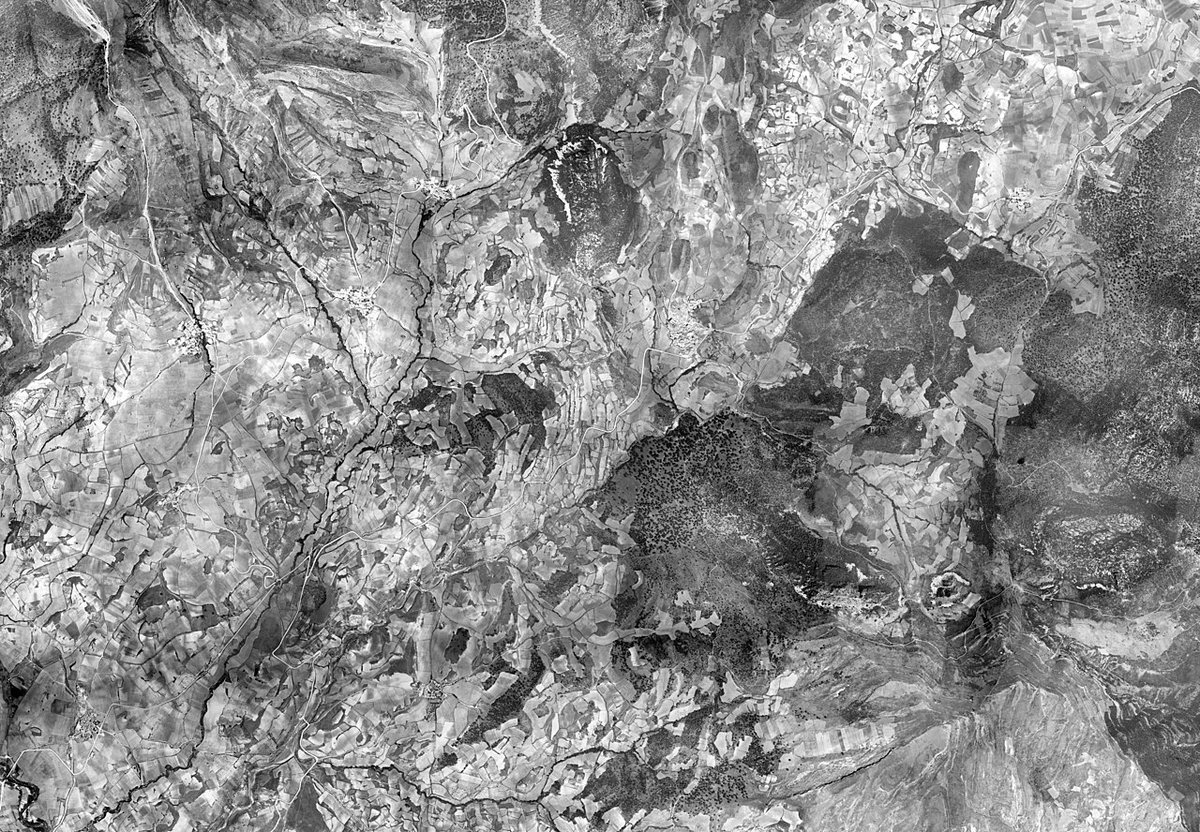
Very quickly, the village edge comes into view. Beyond it, the landscape opens into a sequence of cultivated hills. The colours shift with the seasons. Spring brings strong greens, while ripening cereals turn the land into golds and ochres later in the year. The fields are divided into straight lines that can be seen clearly from any slightly elevated point in the village.
There is no sharp boundary between village and countryside. The transition is immediate, and the openness gives a clear sense of how closely daily life is tied to the land.
Tracks through working land
Several agricultural tracks lead out from Salinas de Oro. These are not signposted walking routes or prepared trails. They are dirt paths used by local farmers to reach their fields. Even so, they can be followed on foot at an unhurried pace.
The terrain is gentle, without steep climbs. Between cereal plots, there are occasional olive groves and small patches of trees. With the village usually visible in the distance, it is easy to keep a sense of direction.
With a bit of patience, it is possible to spot birds of prey gliding over the open fields. Harriers or sparrowhawks are often seen hunting at low height, particularly on calm days in spring and autumn.
In summer, it is worth being prepared. There is very little shade once outside the built-up area, and the heat can build quickly around midday. Water and some protection from the sun make a noticeable difference when walking these tracks.
Seasonal food and nearby options
In this part of Navarra, cooking revolves around seasonal produce. Vegetables often take centre stage: tomatoes, peppers and simple vegetable stews when the time comes. The emphasis is on what is available rather than elaborate preparation.
Sheep’s cheese from the area is common, along with wines from Navarra, which pair naturally with hearty dishes or cured meats. For a wider range of places to eat, nearby villages or the town of Estella‑Lizarra offer more activity and choice.
Festivities and everyday life
The main local celebrations take place around 11 November, for San Martín de Tours. As in many small villages, what happens each year depends on the involvement of residents, so the programme can vary.
During the summer, there are sometimes modest events that bring a bit more life to the streets for a few days. These might include music, neighbourly gatherings or small cultural activities. They are simple and closely tied to the community rather than large-scale celebrations.
Outside these moments, daily life remains quiet and steady, shaped more by routine than by events.
How long to stay and practical notes
The village centre can be seen quickly. In twenty or thirty minutes, it is possible to walk the main streets and reach the edges of the settlement.
Spending a full morning or afternoon allows time to extend the walk along one of the agricultural tracks. From outside the village, its scale becomes clearer: a small cluster of houses surrounded by working fields that continue much as they always have.
Spring and early autumn are usually the most comfortable times to explore on foot. Summer brings strong midday heat and little shade along the tracks. In winter, the days are short and the cold becomes noticeable as soon as the sun drops.
Services within Salinas de Oro are limited, and not everything is always open. For a longer stay in the area, it is more practical to base yourself in nearby towns with more options.
From Pamplona, the usual route is along the A‑12 towards Estella‑Lizarra, followed by local roads. The final stretch runs through fields and low hills, and the journey takes under an hour by car.
Salinas de Oro works well as a quiet stop within a route through Tierra Estella. There are no major monuments or structured tourist plans. What you find instead is a small village, surrounded by cultivated land, where at dusk the sounds of the countryside are still easy to hear before night settles in.