Full Article
about Obanos
Crossroads of the Aragonese and French routes of the Camino de Santiago; a noble town that stages the Mystery of Obanos.
Hide article Read full article
A meeting point on the Camino
There comes a moment on the Camino de Santiago when things feel a bit like a group chat where everyone is talking but no one agrees on where to meet. That is where Obanos appears, right on the Camino between Alto del Perdón and Puente la Reina, quietly hosting pilgrims arriving via the French and Aragonese routes. It works like a natural meeting point, where two separate flows of travellers end up sharing the same space.
This small village in Navarra sits at a key junction. People arrive from different directions, often unaware of each other until they converge here. The effect is subtle but constant: a steady rhythm of footsteps, brief stops, and onward journeys.
A village with an early sense of assembly
With just over 900 inhabitants, Obanos could easily be mistaken for one of those places glimpsed from a car window, the kind that looks calm and unchanging. Yet its past suggests something more active beneath the surface.
During the Middle Ages, Obanos hosted the Junta de los Infanzones de Obanos. This was a kind of assembly where representatives from different social groups gathered to discuss and make decisions together. In a time when authority in many places rested with a single figure, this form of collective discussion stands out as something unusual.
The building linked to these meetings is the Casa del Vínculo. Over time it has served various practical roles, including as a grain store and a municipal space. It is not grand or imposing, but it carries the weight of its changing uses. Like much of the village, it reflects adaptation rather than spectacle, shaped by what the community needed at different moments.
Stone, art and nearby landmarks
The church of San Juan Bautista dominates Obanos. From the outside it is restrained, built in stone in a style typical of Navarra. Inside, however, it holds a Renaissance altarpiece that tends to catch attention even among those without a strong interest in art. It invites a closer look, if only to imagine the hours of craftsmanship behind it.
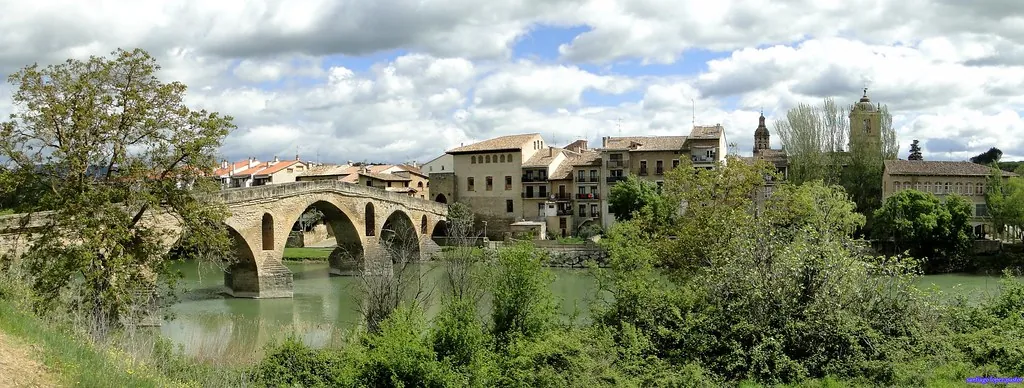
Many pilgrims pause briefly here before continuing towards Puente la Reina, where the two main Camino routes finally merge. In that town stands the church of the Crucifijo, known for its Y-shaped Christ figure. Although it lies outside Obanos, it belongs to the same stretch of the journey and often feels like a natural continuation for those passing through.
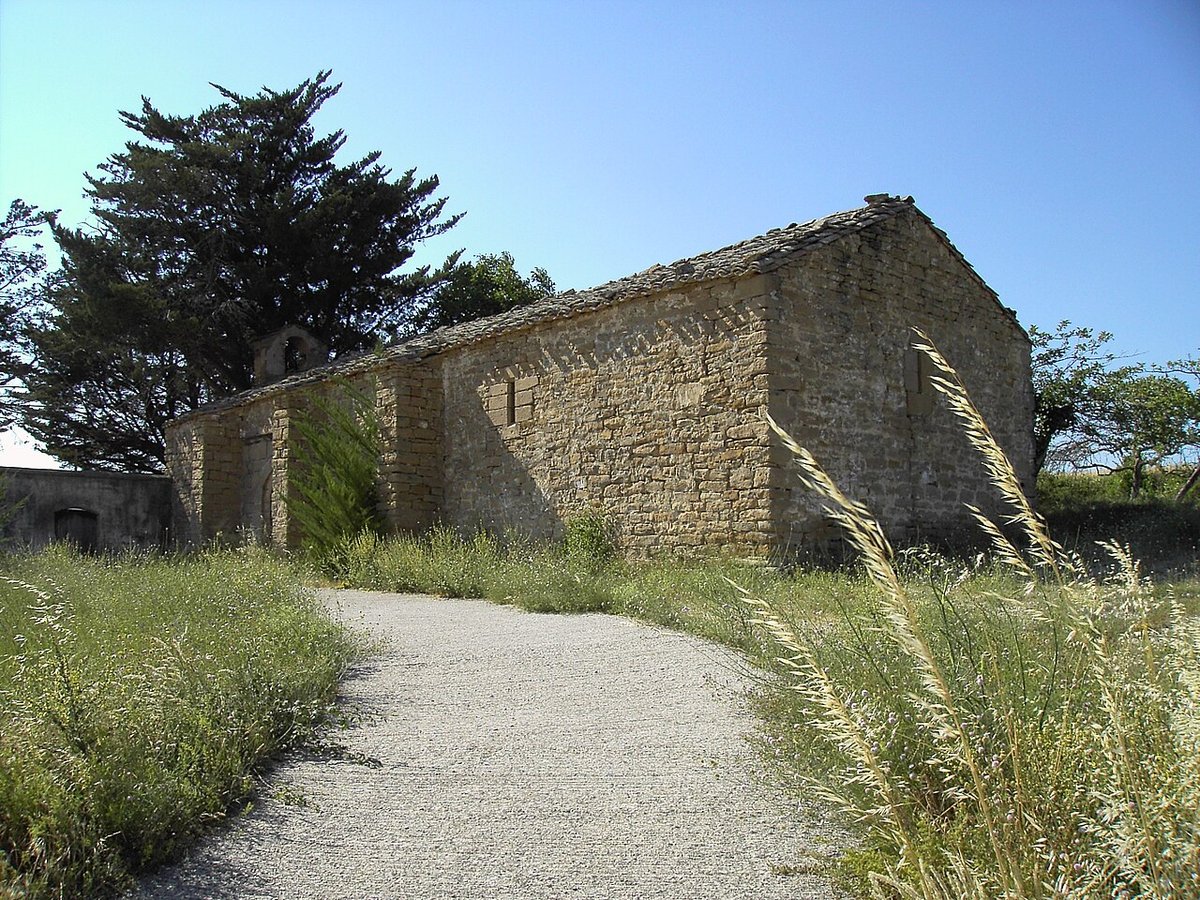
Close by, set among open fields, is Santa María de Eunate. This small, octagonal hermitage surrounded by arches is one of the more recognisable images associated with the Camino. It is not within the village itself, but it can be reached from Obanos in a short time, either by road or on foot with a bit of patience.
The site carries a certain sense of mystery. Excavations uncovered burials of pilgrims marked with scallop shells, a traditional symbol of the Camino. It suggests that many reached this point, but did not continue their journey.
Walking up to Montarraga
For those inclined to go beyond the main route, Obanos offers a path up to Monte Arragado, also known as Montarraga. It is one of those walks locals take simply to stretch their legs.
The route is not technical, though it has enough incline to make the effort noticeable by the time you reach the top. From there, the view opens out across the Valdizarbe valley. Fields spread out in different shades, small roads trace gentle lines, and villages appear placed with care across the landscape.
It is the kind of viewpoint that helps make sense of the area. From above, the course of the Camino becomes clearer, along with the relationship between the route and the settlements that have long depended on it. The movement of pilgrims below feels like part of a much longer pattern.
The value of slowing down
A common mistake is to treat Obanos as a quick stop. The sign appears, there is a short walk through the streets, and then it is back on the way to Puente la Reina. It is an easy rhythm to fall into.
Obanos works better at a slower pace. Sitting for a while in the square reveals a different side of the village. Pilgrims arrive carrying a mix of fatigue and relief. Conversations overlap in different languages at the same corner. Life continues around them, with locals passing through, greeting one another, and carrying on with their day.
The atmosphere shifts with the seasons. In spring, the surrounding countryside turns a vivid green and the days stretch out. Summer brings a greater flow of pilgrims along the Camino. Autumn changes the colour of the nearby vineyards, adding another layer to the landscape. Winter is quieter and noticeably colder, with fewer travellers passing through.
Obanos does not compete with large cities or headline destinations. Its appeal lies elsewhere. It remains a village that functions as a village, shaped by daily routines and long-standing patterns. Pilgrims have been passing through for centuries, and that movement continues without disrupting the steady life of the place.
There is something to be said for stopping properly, even if only for a short while. In a journey defined by progress, Obanos offers a reminder that pauses can be just as meaningful as the miles covered.