Full Article
about Puente la Reina
Crossroads of Jacobean routes; known for its magnificent Romanesque bridge over the Arga and its main street.
Hide article Read full article
Where the Camino Converges
In Puente la Reina, the first thing to think about is the car. The main car park sits on the far side of the river. Leave the vehicle there and cross on foot. Within a couple of minutes you are on the main Camino street, where two long routes of the Camino de Santiago come together. One arrives from Roncesvalles, the other descends from Somport. Two steady flows of backpacks merging into a single street.
This meeting point shapes the town. Early in the day, the rhythm is set by pilgrims setting off. There is a quiet sense of movement rather than bustle, with people passing through rather than staying long.
The Bridge That Gave It a Name
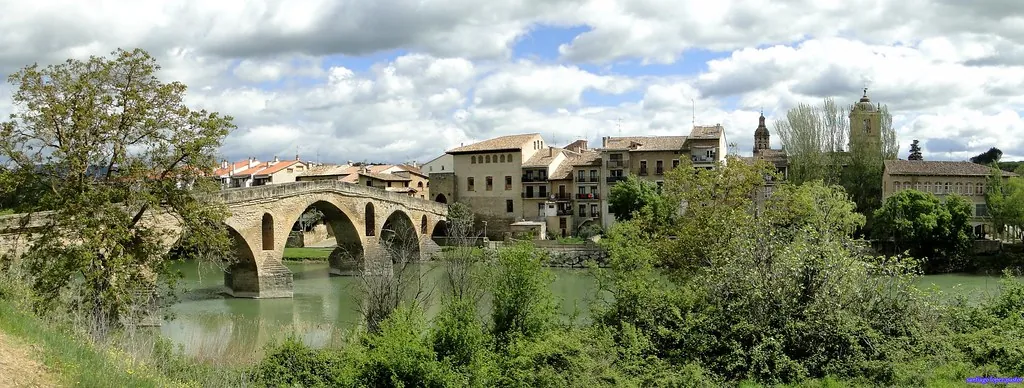
The bridge is what defines Puente la Reina. It stretches just over one hundred metres and is built with six arches. It dates back to the medieval period, commonly said to be from the 11th century. A queen of Navarra ordered its construction to make crossing easier for those on the Camino, and the name of the town followed.
For its time, the bridge is wide. It was not just for pilgrims on foot. Carts and livestock also passed across it, which explains its generous proportions.
If the aim is to see it without crowds, early morning is the best moment. By mid-morning, groups of walkers and a fair number of cyclists are already moving through.
Before the first arch, a wooden staircase leads down to the riverbed. From below, the structure of the bridge becomes clearer, especially its foundations. The river here is the Arga, and it usually runs clear. Stand still for a while and fish become visible in the water.
There is a small detail that often goes unnoticed. On one of the bridge’s pillars, a small Virgin sits inside a niche. A local legend tells of a bird that used to clean the figure every morning with its beak. Today the niche is protected by a metal grille.
Behind the Main Street
The old town is simple in layout. Three long, parallel streets run through it, with the central one aligned with the Camino. In the morning, the smell of coffee and toasted bread drifts out, as pilgrims tend to leave early.
The two outer streets are more ordinary in feel. A pharmacy, a bakery, a workshop or two. Everyday life continues here without much fuss.
Near the entrance to the town stands the church of the Crucifijo. Inside is a wooden Christ with a Y-shaped cross, something unusual to see. Tradition links it to the Knights Templar, though details tend to be left vague.
The church of Santiago is larger. It was reworked in the 16th century, with Baroque altarpieces added later. It also houses a dark-coloured image of Santiago. Around here, stories circulate about a fire connected to the church, though no two versions seem quite the same.
Close by is the Plaza Mayor. Today it is an open space with stone benches. In the past it had arcades, but they were removed centuries ago because they got in the way of the market.
Food in Puente la Reina
The cooking here leans towards the straightforward. Typical dishes include pimientos del piquillo, cordero guisado and trout when it is available. Nothing complicated.
Pimientos del piquillo are a type of red pepper from the region, often prepared in different ways. They might appear in a salad, stuffed, or simply served with oil and salt. When they have been roasted the same day, it shows in the flavour.
Wine is usually from Navarra. Whites tend to come from higher مناطق, while reds are associated with the Ribera area further south.
During Semana Santa, a common sight in bakery displays is torrijas. This is a traditional sweet similar to French toast, often made here with sweet wine and cinnamon.
Walking On or Staying Put
There is a short local route that links several fountains around the town. It passes through fairly built-up areas and is mainly useful for stretching the legs rather than exploring countryside.
A more pleasant option is to follow the river Arga towards Obanos. The path is flat and quiet, passing irrigation channels, vegetable plots and the occasional fisherman.
For those continuing along the Camino towards Cirauqui, it is around seven kilometres with gentle climbs. The first stretch is on asphalt, then it turns to dirt. It is worth carrying water, as there is very little between Puente la Reina and Mañeru.
A Practical Pause
Puente la Reina is quick to cover. The bridge, a walk along the main street, and not much more.
The sensible approach is to stop for a while while passing through on the Camino, have something to eat, then continue the journey.
At times in autumn, fairs are organised around the pimiento. The town fills up, and the smell of roasting peppers drifts as far as the bridge. The main festivals tend to take place in summer, when there is a livelier atmosphere.
It is best to park outside the old town and walk in. Trying to bring a car into the centre usually ends in a long detour or a fine. Everything here is within five minutes on foot, which makes walking the obvious choice.