Santa Catalina Tresponde
País Vasco · Atlantic Strength

Iruña Oka (Iruña de Oca)

The church bell strikes eleven and the only other sound is a cyclist freewheeling past the fronton court, tyres hissing on damp tarmac. At 560 m ab...

3,704 inhabitants · INE 2025
500m Altitude

Why Visit

Mountain Main square Hiking

Best Time to Visit

spring

Things to See & Do
in Iruña Oka (Iruña de Oca)

Heritage

  • Main square
  • Parish church
  • Viewpoint

Activities

  • Hiking
  • mountain biking
  • viewpoints
  • local cuisine

Full Article
about Iruña Oka (Iruña de Oca)

Deep green, farmhouses, nearby mountains with trails and viewpoints.

Ocultar artículo Leer artículo completo

The church bell strikes eleven and the only other sound is a cyclist freewheeling past the fronton court, tyres hissing on damp tarmac. At 560 m above sea level, Iruña Oka sits high enough for the air to feel sharper than in Vitoria-Gasteiz, 12 km to the north-west, yet low enough for holm oaks and vegetable patches to survive on the same slope. This is not one of those mountain villages that clings to a cliff for the sake of a photograph; it is simply a place where the road climbs, the houses thin out, and life continues at a pace dictated by rainfall and the ripening of peppers.

A village you can walk across in the time it takes to drink a coffee

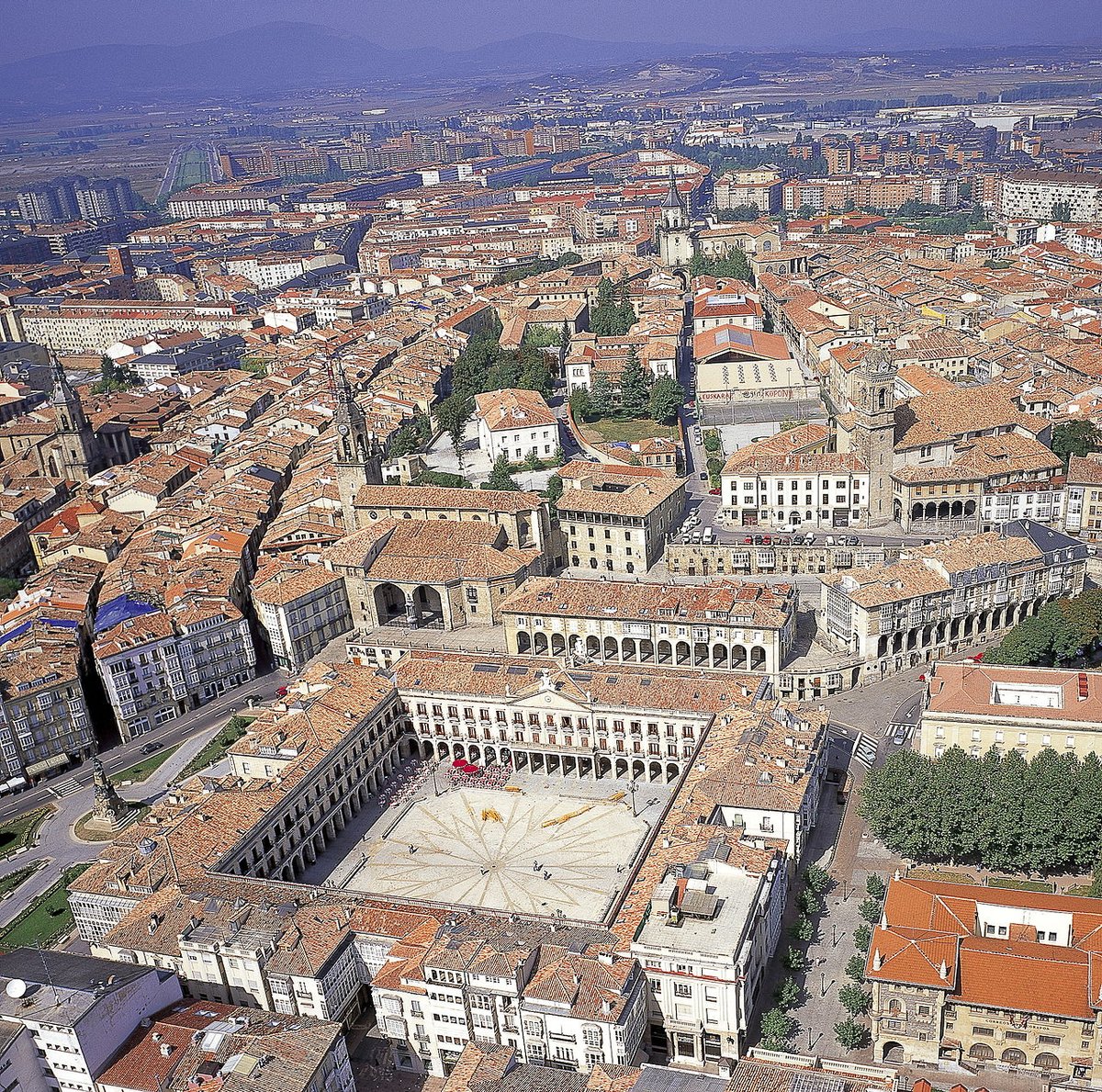
Most visitors arrive by car, swing into the small Plaza de la Constitución, and realise they have already seen half the settlement. The medieval core is three streets deep. Stone houses with wooden balconies lean slightly, not for tourist effect but because they are old and built on clay that swells in winter. There is no ticket office, no audioguide, no souvenir stall selling fridge magnets. Instead, you get the smell of wood smoke from a chimney and a woman sweeping leaves into a neat pile outside her gate.

Start at the Iglesia de San Andrés. The door is usually locked unless mass is due, yet the building’s bulk—Romanesque base, Gothic remodel, twentieth-century patch-ups—tells the story of a community that repaired rather than replaced. Walk clockwise around the church and you will find a low stone wall perfect for sitting. From here the land falls away south-east towards the Zadorra reservoir, a silver thread between cereal fields. On clear days the limestone edge of the Sierra de Toloño appears 40 km away, a pale wall marking the Riojan border.

Tracks that leave the village and keep going

Iruña Oka is the starting point for two distinct types of walk. The first is the 45-minute loop used by locals after lunch: head past the fronton, take the concrete lane signposted “Ermita vieja”, fork right at the second water trough, and you are on a dirt track that circles back through oak scrub. Spring brings wild garlic and the sound of cuckoos; after October the same path turns to sticky ochre that cakes boots and bicycle tyres alike.

The second option is longer and requires a map, because waymarking stops at the municipal boundary. Follow the Camino de las Cañadas north-west and you drop into a shallow valley where sandstone has been quarried since the 1400s. The track eventually joins the GR-25 long-distance trail at the village of Zambrana, 10 km on. Total ascent is modest—210 m—but the open plateau exposes you to wind that can knock three degrees off the temperature. Carry a layer even in July.

Cyclists favour the minor road that links Iruña Oka with Bernedo, 14 km south. Traffic is light except at 07:30 when milk tankers rattle through, yet the surface varies from smooth asphalt to patched sections where winter frost has lifted the edges. A hybrid bike is safer than skinny road tyres.

What you will not find (and why that matters)

There is no bar in the historic core. The nearest place for a cortado is the petrol-station café on the A-3011 roundabout, a ten-minute walk from the church square. Locals treat this as social hub: men read the Noticias de Álava aloud to each other, women queue for lottery tickets, and the television shows cycling repeats with the sound off. Order a tostada con tomate and you will be asked “Pan de pueblo o normal?” The village loaf is crustier, cuts the roof of your mouth, and costs 40 c extra.

Accommodation is equally scarce. A single rural house rental sleeps six; otherwise you stay in Vitoria-Gasteiz and drive out. This limits evening options, but it also means the lanes stay quiet after dusk. Night skies reach magnitude 5 on the Bortle scale—faint Milky Way, no street glare—because the municipality refuses to install the standard Spanish white-blue LEDs.

Weather that changes while you are still looking at it

At 560 m, Iruña Oka catches weather systems sliding off the Cantabrian Sea. One April morning can begin with fog so thick the church tower disappears, lift to 22 °C by midday, and finish with hail rattling against car roofs. The annual rainfall of 750 mm falls mainly in 48-hour bursts; when that happens, the unpaved walks become axle-deep in clay. If the forecast shows two consecutive days of orange alert, postpone the visit. Conversely, July and August stay pleasantly below 30 °C thanks to the altitude, though afternoons can feel airless when the wind drops.

Winter brings sharper frosts than Vitoria itself. Daytime highs hover around 6 °C; overnight the thermometer can touch –5 °C. The village road is gritted promptly, but the minor approach from the N-622 is not. Chains are unnecessary for a day trip, yet rental cars with summer tyres have been known to slide backwards on the 12 % gradient above the cemetery.

Language, lunchtimes and other small courtesies

Basque (euskera) appears first on every signpost. Attempting “kaixo” (kai-show) instead of “hola” earns a nod, not a round of applause; the effort is noted and conversation switches to Spanish without comment. English is rarely spoken, so bring a phrasebook or offline translator if you need directions beyond pointing.

Shops observe the classic Alavan timetable: open 09:00-13:30, close, reopen 17:00-20:00, shut on Sunday afternoons and all Monday. Picnickers should stock up in Vitoria before driving out. The village fountain looks photogenic but is labelled “no potable”; the water is high in nitrates from surrounding farmland.

A honest verdict

Iruña Oka will not keep a checklist-tourist busy. You can absorb the layout, climb the adjacent hill and photograph the stone bridge on the Zadorra within 90 minutes. What the place offers instead is a calibrated sense of scale: how big the sky feels when there are only 5000 souls beneath it, how quickly modern life shrinks when the loudest sound is a blackbird. Come prepared to slow down, bring waterproof footwear between October and May, and plan to linger rather than conquer. If the weather closes in, Vitoria-Gasteiz’s Artium museum is 20 minutes away by car. Yet on a clear evening, when the setting sun catches the limestone walls and the air smells of wet earth and wood smoke, the temptation is to stay exactly where you are and let the world continue without you.

Key Facts

Region
País Vasco
District
Cuadrilla de Vitoria-Gasteiz
INE Code
01901
Coast
No
Mountain
Yes
Season
spring

Livability & Services

Key data for living or remote work

2024
ConnectivityFiber + 5G
Housing~5€/m² rent · Affordable
Sources: INE, CNMC, Ministry of Health, AEMET

Official Data

Institutional records and open data (when available).

  • Torre de Mendoza
    bic Monumento ~5.5 km
  • Conjunto Arqueológico de Iruña-Veleia
    bic Monumento ~3.2 km
  • Puente de Trespuentes
    bic Monumento ~3.4 km
  • Jardín Botánico de Santa Catalina
    bic Monumento ~3.6 km
  • TORRE DE ARGANZON
    bic Castillos ~3.4 km

Planning Your Visit?

Discover more villages in the Cuadrilla de Vitoria-Gasteiz.

View full region →

More villages in Cuadrilla de Vitoria-Gasteiz

Traveler Reviews