Full Article
about Bilbo (Bilbao)
Valleys and hamlets a stone’s throw from Bilbao, buzzing with local life.
Hide article Read full article
At nine in the morning in the Mercado de la Ribera, the air carries the smell of fresh txipirones and recently ground mustard. A man in a white apron shakes out a sheet of paper over the scales while explaining to a customer how to clean kokotxas de bacalao, the delicate pieces of cod often prized in Basque cooking. In the background, a radio drifts from football talk to a popular song. This is how Bilbao wakes up: to the clatter of spoons against pans and a salty scent rising from the ría as the tide drops.
From the Puente de San Antón, the same spot where one of the historic crossings of the town once stood, the city’s transformation is visible in brick and steel. To the left, the Casco Viejo presses its rows of muted-colour houses close together, as if sheltering from the wind. To the right, office buildings line the riverbank. The water moves slowly, a dense grey, navigable many kilometres inland. That geographical feature shaped Bilbao into an industrial port long before tourism entered the conversation.
A city that changed its skin
When the Guggenheim opened at the end of the 1990s, many locals viewed the titanium structure with suspicion, as though it had landed from another planet. Today, the steps around it work almost like a shared living room. Children run around the flower-covered dog, people sit facing the ría, and skaters make use of the smooth edges of the square. The titanium shifts in tone with the light, cool grey in the morning, turning orange as the sun drops behind the buildings of Abando.
Yet Bilbao does not end there. A short walk towards the Casco Viejo leads to the Siete Calles, the medieval core of the town founded in 1300. Narrow façades, balconies with washing hanging out, and the constant murmur of people moving in and out of shops still set the pace of the neighbourhood. On Sundays, Plaza Nueva often fills with stalls selling collectibles and antiques. The arcades keep their shade even on the hottest days, and groups of friends gather, leaning against the columns and talking at length.
Where the stomach sets the pace
Around midday, the Casco Viejo fills with people moving between bars, a rhythm that revolves around pintxar, the local way of eating small bites rather than sitting for a single long meal. On one tray there might be tortilla de bacalao, still warm; on another, txangurro gratinado, with its scent of the sea and a recently opened oven. Small glasses of beer, known as zuritos, pass quickly between conversations.
In many homes across Bilbao, recipes are still passed down without written instructions or exact measurements. A grandmother moves a pan gently to bring together a pil‑pil sauce, explaining that the oil must be warm and that patience matters more than force. Garlic begins to turn golden, the cod releases its gelatin, and the kitchen fills with a soft aroma of hot oil that lingers on clothes.
Food here is not only about what is eaten but how it is shared. Time stretches around the table, and conversation carries as much weight as the dishes themselves.
August and December: two faces of the city
In mid-August, Bilbao shifts its rhythm with Semana Grande. The comparsas, local festival groups, appear and the streets fill with music and people returning to their neighbourhoods for a few days. Giants and big-headed figures parade through the crowds to applause, while at night the ría lights up with fireworks. During this period, the city centre becomes especially lively, and the celebrations continue well into the night.
A quieter side of Bilbao usually appears in December, around the day of Santo Tomás. Plaza Nueva fills with stalls selling farm produce and crafts. Many people wear traditional clothing, with txapela, the Basque beret, and dark neckerchiefs. The air smells of cider, freshly made talo, a type of flatbread, and roasted chestnuts. The atmosphere leans more towards a neighbourhood gathering than a large-scale event.
These two moments in the calendar show different sides of the same place: one expansive and festive, the other closer to everyday traditions.
Seeing Bilbao from above
The metro is part of the city’s daily landscape. Its curved glass entrances, known as fosteritos, rise from the pavements like transparent bubbles. Inside, the space opens wide, with steel and dark stone. When trains arrive, the sound echoes as if in an industrial hall.
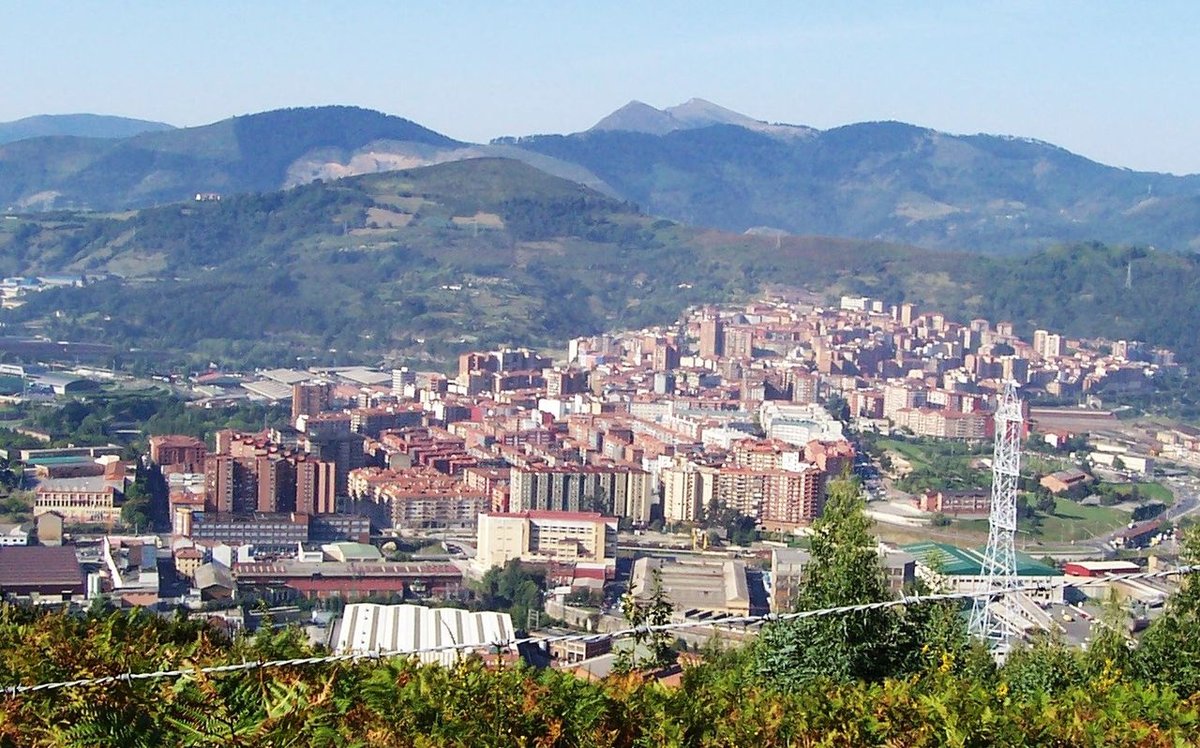
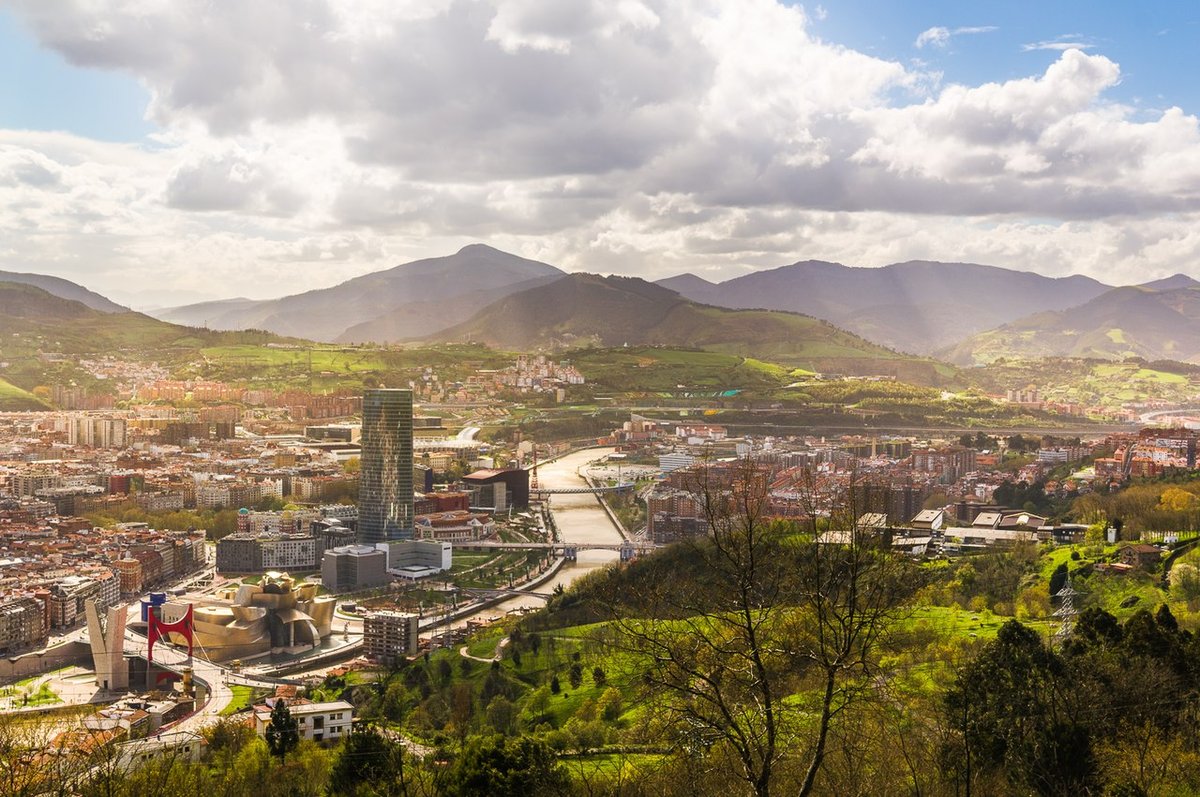
To grasp the shape of the valley, a trip on the funicular de Artxanda helps. In just a few minutes, the carriage climbs the hillside through trees and scattered houses. At the top, Bilbao spreads out like a model: the ría tracing a slow curve, neighbourhoods climbing the slopes, bridges linking one bank to the other.
Spring is often a good time to visit, with longer days, less frequent rain, and fewer crowds than in the height of August. One simple detail is worth keeping in mind: in Bilbao, time at the table moves slowly. Conversations after a meal are given as much importance as the food itself, and the day unfolds at that unhurried pace.