Full Article
about Gijón
Capital of the Green Coast
Hide article Read full article
The wind from the estuary whistles through the masts in the harbour as the city wakes. From the hill of Santa Catalina, the concrete form of Elogio del Horizonte stands out against the Cantabrian Sea. Tourism in Gijón often begins up there, where the scale of the place becomes clear: a large city by Asturian standards, open to the sea and shaped over time. From the Roman settlement known as Gigia to the industrial port of El Musel, the sea here is not just scenery. It is work and memory for a population of around 270,000 people.
The sea that shaped the city
Geography explains much of Gijón. A relatively sheltered stretch between Cabo Torres and the area of Peñarrubia allowed a small natural harbour to form early on. On the Cimavilla peninsula, the oldest part of the city, Roman remains have been documented. Among them are baths that can be visited today near the church of San Pedro. It was not a major city of the Empire, though it played an active role in the Cantabrian coastal network.
In the upper part of Cimavilla, sections of Roman wall still survive, dated to around the 3rd century. The stone was reused for centuries in different buildings, a common practice in port cities where good material was never abundant.
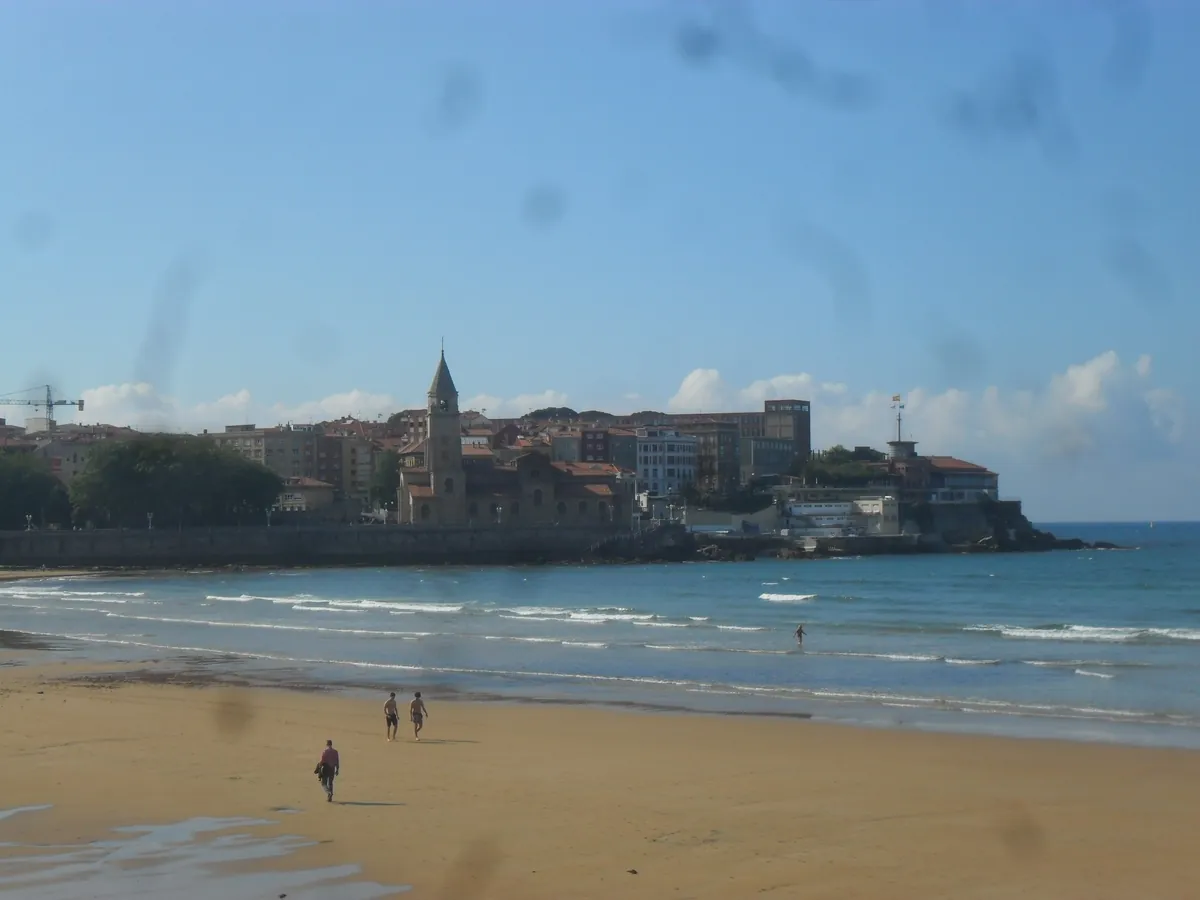
The church of San Pedro seen today is largely a 20th-century reconstruction. The medieval building was badly damaged during the Spanish Civil War. Its position, however, has not changed. It still stands at the edge of the neighbourhood facing the sea, marking the boundary between San Lorenzo beach and the old quarter.
From fishing port to industrial city
Well into the early modern period, Gijón was primarily a fishing town. The major shift came in the 19th century with coal mining in the inland valleys. The port expanded to handle this traffic and, by the late 19th and early 20th centuries, the port of El Musel was planned as infrastructure on an industrial scale.
This development transformed the city. New streets were laid out towards the south and west, while markets, public facilities and railway stations appeared, linking Gijón with the mining areas and the Spanish interior. For decades, chimneys and workshops defined the edges of the urban landscape.
The industrial crisis of the late 20th century changed direction again. Some of those spaces have since been repurposed, and the city has strengthened its cultural and university role. At the same time, tourism has grown, linked to the beach, local food and museums.
Cimavilla: where it began
Climbing up to Cimavilla remains the most direct way to understand Gijón. The neighbourhood sits on a small peninsula that pushes into the sea, with narrow streets arranged to shelter from the wind. For centuries, this was home to fishermen and port workers.
In Plaza de Jovellanos stands the birthplace of the Enlightenment figure from Gijón, now a museum. Jovellanos was a central figure in 18th-century Spanish reformism, and his name is still closely tied to the city’s cultural identity.
Nearby are the Roman baths of Campo Valdés, excavated in the late 20th century. Walking through the site reveals how these public bath complexes functioned and shows how the small settlement of Gigia was part of Roman urban life.
At the end of the peninsula lies the hill of Santa Catalina. In 1990, Eduardo Chillida’s Elogio del Horizonte was installed there. The sculpture has since become one of the most recognisable elements of Gijón’s skyline.
Cider and everyday cooking
Cider is part of daily life across Asturias, and Gijón is no exception. The act of escanciar, pouring cider from a height so it strikes the rim of the glass, is not a display for visitors. It is the traditional way of aerating the drink, which is served in small amounts and poured repeatedly over the course of a conversation.
Gatherings around cider are usually accompanied by dishes designed for sharing. Asturian cooking follows a straightforward logic, based on nearby produce and filling recipes. Fabes with clams, fish from the Cantabrian Sea and locally raised beef appear frequently.
The cachopo, now common throughout Asturias, began to gain popularity in Gijón in the last third of the 20th century. It consists of two beef fillets filled, typically with ham and cheese, then breaded and fried. It is served in large pieces and is usually shared.
Moving around Gijón
The centre of Gijón is easy to explore on foot. From Cimavilla to the eastern end of San Lorenzo beach, a continuous seafront walk helps with orientation and connects key areas of the city.
An urban bus network links the centre with more distant neighbourhoods and areas such as El Musel or Somió, where the Museo del Pueblo de Asturias is located. This museum, set in open surroundings, focuses on Asturian rural life and traditions.


