Full Article
about Ponte Caldelas
Hide article Read full article
The scent of wet slate rises from the riverbed at A Calzada. It’s a clean, mineral smell that hangs in the air even on dry days. Step into the Verdugo in July and the cold is a shock, a tight grip around your ankles from water that runs dark and clear over polished stones. This river beach in Ponte Caldelas was among the first inland spots in Galicia to fly a Blue Flag. The official plaque is fixed to a post by the bank, but what matters is the water itself—its temperature, its clarity, the way it defines the pace of things here.
People come to swim when the heat builds, but the riverbank is a constant. Women still beat rugs on the flat stones by the bridge. The current moves with a low, steady sound.
Stone Arches and Midday Meals
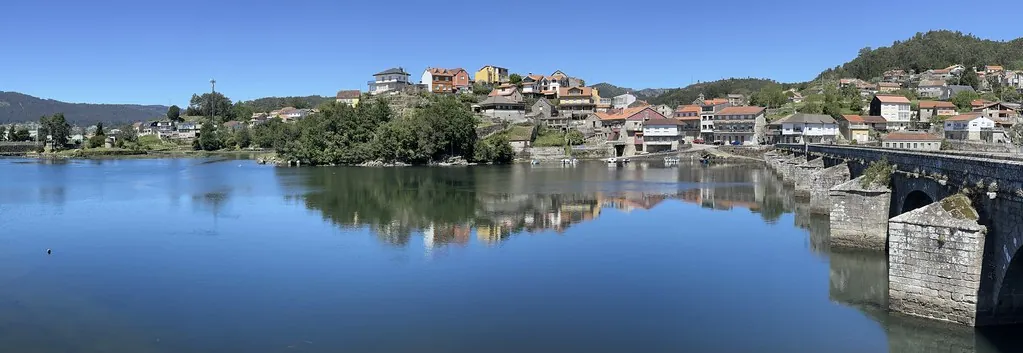
A walking path follows the Verdugo upstream from A Calzada. It leads to the bridge that gives the concello its name. The structure dates from around the sixteenth century, four semicircular arches of worn granite. In late afternoon, when the sun aligns with the central span, the light cuts through and turns the river surface beneath into shifting sheets of brass.
Just past the bridge, the arcades of the main square provide shade. By one o’clock, the smell of simmering pork and turnip tops drifts from kitchen windows. Menus here are straightforward. You’ll find lacón con grelos, thick soups, and on some days, a scallop empanada if you arrive early. The bread is often pan de millo, made from local maize, with a dense, yellow crumb.
The Carvings at Tourón
Five kilometres upriver, past bends where herons stand in the shallows, the landscape changes. The road climbs into Tourón. Here, on sun-warmed slabs of granite, prehistoric petroglyphs spread across the hillside. The carvings show concentric circles, deer with antlers arcing back, outlines of feet. The grooves are deep enough to cast shadows in the slanting light. Touch them and you feel the weather-smoothed grain of the stone.
A narrow track leads from there to the small church of Santa María. Its Romanesque corbels are softened by lichen, but you can still make out a figure playing a stringed instrument. The place feels anchored, grown into the hill rather than built upon it.
From this point, an old royal path stretches toward the archaeological zone. It’s a long walk if you follow it entirely—eighteen kilometres return. Most people don’t. A shorter diversion leads to the Foxo do Lobo, an old wolf trap now mostly reclaimed by ferns and blackberry brambles. The stone walls form a deep funnel in the earth, damp and cool at the bottom.
Timing Your Visit
The rhythm of Ponte Caldelas shifts noticeably in late August during the romería of San Vicente. The bridge fills with families, the sound of bagpipes carries over the water, and cars line every available patch of grass along the roads. It has energy, but also congestion.
Come in June instead. The river is still brisk, the eucalyptus groves on the hills smell sharp after rain, and you can have A Calzada largely to yourself on a weekday morning. If you must visit in August, avoid weekends. Parking near the river becomes a patient exercise.
A View from O Casteliño
For perspective, take the track uphill from Santa Baia church toward O Casteliño. It’s a two-kilometre walk on loose stone. The climb is gradual. From the top, you see how Ponte Caldelas is not one town but several parishes—Caritel, Forzáns, Xustáns—strung along the Verdugo’s course like beads on a thread. The river is a silver line in the green.
Evening brings the smell of cut grass and cold hearth smoke. You might hear a tractor in a distant field or the crack of someone splitting wood for winter.
By nightfall you’re back at the bridge. A lone streetlamp throws yellow light onto the arches. Below, black water moves silently toward the sea, carrying that scent of moss and slate all the way down to the ría. It’s a smell that stays on your skin after you’ve left, long after you’ve driven away from Ponte Caldelas and its cold river