Full Article
about Vilaboa
Hide article Read full article
A municipality shaped by the ría
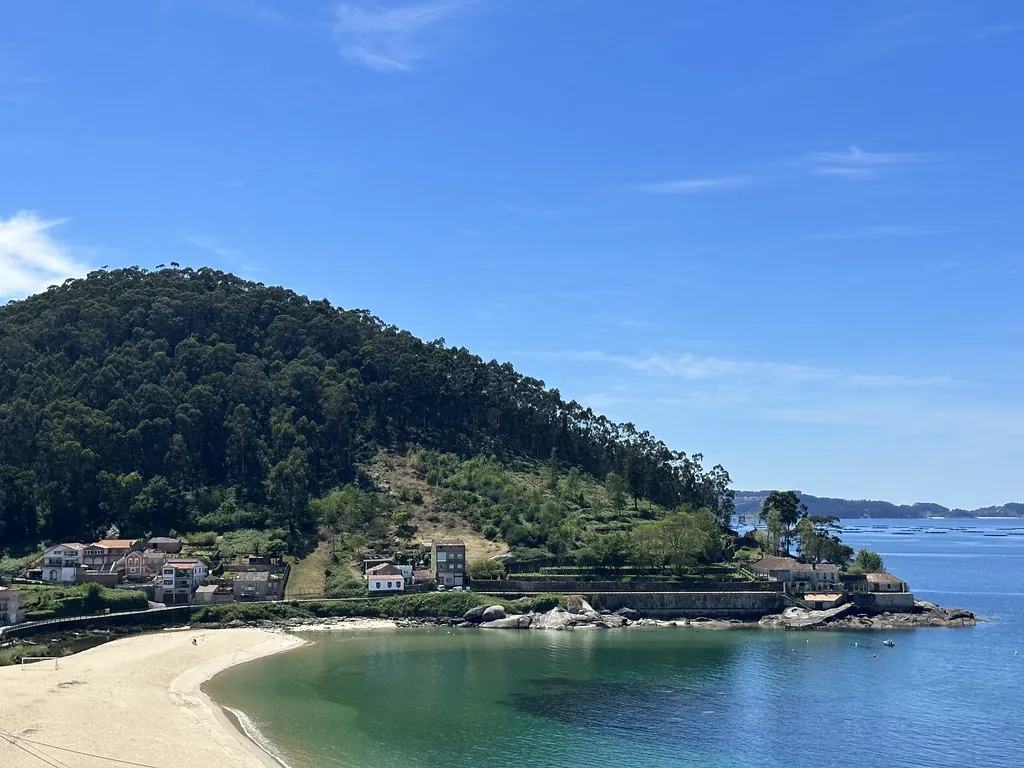
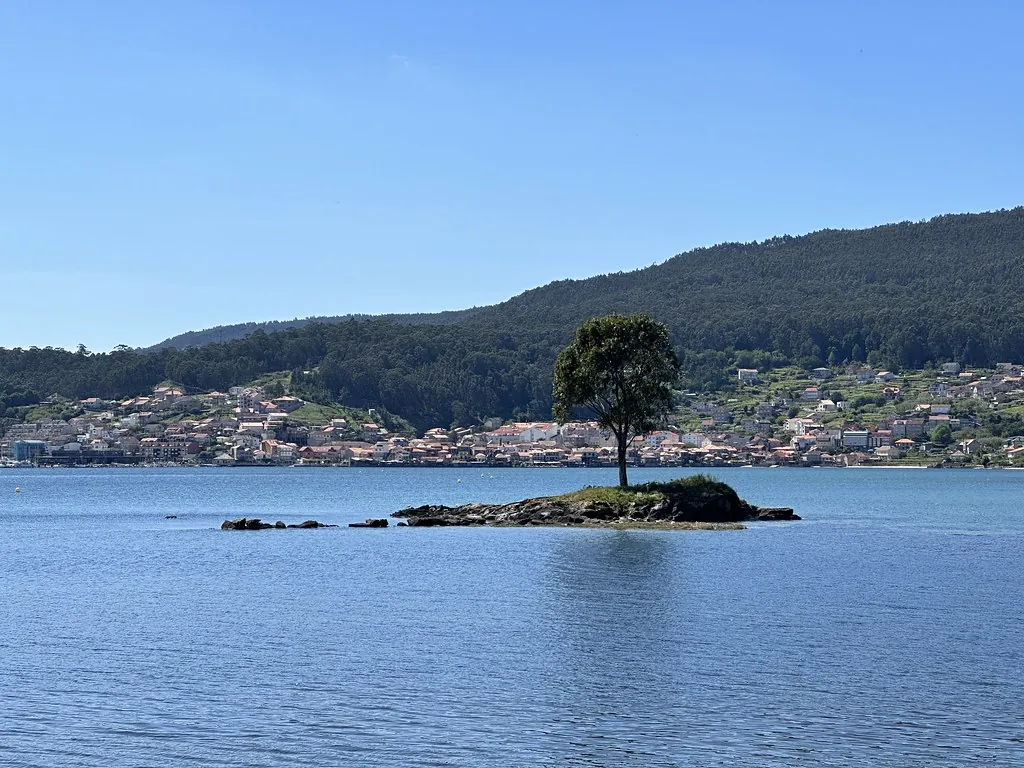
Tourism in Vilaboa usually begins by the water rather than in a town centre. The road that descends from Pontevedra passes mussel rafts, small jetties and industrial buildings linked to shellfishing and preserving. Traditional houses, many of them low with pitched roofs, seem built to withstand salty air rather than to draw attention. Vilaboa does not reveal itself at a glance. It takes time to move between parishes, follow paths by the water and climb slopes that look out over the ría de Vigo.
This is not a single compact settlement but a spread of small communities. The sea, the hillside and old parish routes connect them. Everyday life has long been divided between what happens along the shore and what happens further inland. The result is a place that feels dispersed yet coherent, held together by the rhythm of the tides.
The water that gave it its name
The presence of the river Maior explains much of Vilaboa’s history. It flows into the ría here, forming a sheltered inlet where the tide moves in with ease. That balance between fresh and salt water supported activities linked to salt production for centuries.
The Salinas de Ulló lie in this intertidal zone. They operate using a very old system that takes advantage of the tidal cycle. Seawater enters through channels and is retained in a series of shallow ponds where the salt gradually concentrates. For a long period the salt pans were abandoned. Today they are worked again on an artisanal basis and also serve as a space for birdwatching.
During the months when production is under way, piles of white salt stand out against the dark mud of the ponds. Wading birds feed nearby, drawn to the shifting edge between land and sea. Early in the day, when mist still lifts from the ría, the area has a stillness that is increasingly rare along the coast.
The setting also makes clear how closely the local economy depended on the natural cycle. The tides determine when water enters the system and when it remains trapped. The landscape itself records that interaction, shaped by channels, embankments and shallow basins.
Along the mills of the river Maior
A short distance from the estuary, the river Maior narrows and begins to descend more steeply. That change in gradient allowed several watermills to be built, some documented since the Early Modern period. Several survive along the riverbank today, linked by a footpath that follows the course of the water.
The walk offers a clear view of how these mills functioned. Small weirs diverted part of the flow. Narrow channels carried it towards the mill. The cubo, a vertical shaft where water collected before dropping onto the wheel, provided the necessary force. In some cases, interior machinery or parts of the wooden structure remain.
The technical details tell only part of the story. The group of mills helps to imagine the traditional economy of the area. Inland parishes relied on them to grind grain. Along the coast, life revolved around shellfishing and the mussel rafts that still mark the surface of the ría. In Vilaboa, these two spheres have always existed side by side, close enough to influence each other.
The path beside the river is short and can be taken at an unhurried pace. In rainy periods the ground is often damp, so sturdy footwear is advisable. The route feels modest in scale, yet it offers insight into how water powered daily work.
Petroglifos on the slopes of Castrove
On the slopes facing Monte Castrove, several groups of prehistoric petroglifos appear on exposed rock. Such carvings are relatively common in the Rías Baixas. The motifs tend to include concentric circles, cup marks and other geometric figures incised directly into stone.
In this area there are also more recent engravings made by a local resident in the twentieth century. He continued to use the same traditional motifs. These carvings are not archaeological pieces, yet they form a curious continuation of that ancient visual language on rock.
A footpath passes close to these rocky outcrops. From certain points the view opens over the ría. The grid of mussel rafts becomes clearly visible, altering its shape according to the tide and the light. The contrast between prehistoric markings underfoot and the contemporary pattern of aquaculture on the water adds another layer to the landscape.
Parish festivals that remain local
Celebrations in Vilaboa retain a strong link to each parish. Carnival, known in Galicia as entroido, is particularly lively in places such as San Adrián. Comparsas, traditional costumes and performances combine humour, social commentary and custom. The tone is rooted in local life rather than designed for visitors.
Autumn also brings romerías connected to the agricultural calendar. Around San Martiño it is common to find stalls, roasted chestnuts and popular music. These gatherings bring together people from nearby parishes more than they serve as large-scale events for outsiders. The emphasis lies on continuity, on marking moments in the year that still matter to the community.
Finding your bearings
Vilaboa lies a few kilometres from Pontevedra and very close to the Rande Bridge, one of the main access points to the ría de Vigo. The most practical way to explore the municipality is by car, moving between parishes and leaving the vehicle behind for short walks.
The riverside mill path is brief and suitable for a relaxed visit, with the caveat that wet weather makes the ground slippery. To reach the salt pans or viewpoints over the ría, it is best to proceed slowly and turn down the small lanes that lead towards the water.
Vilaboa does not function as a single urban centre. It is better understood as a mosaic of places connected by the ría, the hillside and old parish routes. Water shapes its past and present, from the tidal ponds of the Salinas de Ulló to the current of the river Maior. Time and tide have left their mark here, and the only way to grasp it is to follow those traces across the landscape.